Enhancing Early Childhood Education through Anganwadi Capacity Building: A CLR Model
This program, developed by the Centre for Learning Resources (CLR), focuses on building the capacity of Anganwadi workers and the community to enhance early childhood education (ECE). It emphasizes acquiring knowledge and skills needed to work effectively with children, fostering positive self-concepts, and facilitating cognitive development through activity-based learning. The model includes tailored training, practical resources, and a monitoring system to ensure best practices in ECE are adopted within Anganwadis. The goal is to improve the quality of ECE and cultivate an environment of nurturing and effective education.

Enhancing Early Childhood Education through Anganwadi Capacity Building: A CLR Model
E N D
Presentation Transcript
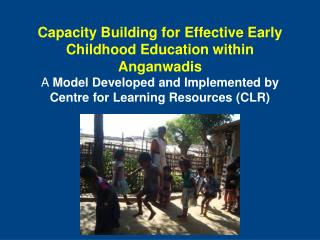
Capacity Building for Effective Early Childhood Education within Anganwadis A Model Developed and Implemented by Centre for Learning Resources (CLR)
Focus on • Acquisition of knowledge • Acquisition of skills • Developing the attitude needed to work with children • Evaluation Participants – Anganwadi Workers, Anganwadi Helpers, Supervisors, CDPO, Trainers at AWTC, Trainers at MLTC, and Parents & Community
Capacity Building Process • Developing ECE Program Outcomes and Indicators • Deciding the implementation Strategy • Adopting & Contextualizing CLR’s Developmentally Appropriate ECE Curriculum
Physical Development / Health / Hygiene Social and Emotional Development Development of positive self concept, self confidence, sociability with peers and adults. Cognitive Development (‘Thinking Things Out’) Development of concepts related to the child's world; reasoning abilities; divergent thinking CLR Eclectic ECE Curriculum (Activity-based) Creative Expression Art activities; music and movement; creative play Language Development : Receptive and expressive language skills Beginning Mathematics Early number and spacial concepts, and related vocabulary Emergent Literacy Phonological and phonemic awareness; orientation to print; readiness for writing
Capacity Building Process 4. Putting together an ECE kit • CLR ECE Kit • A set of easily replenishable learning materials correlated with the curriculum with a guidebook • Play materials • Material collected from the environment • Teacher Prepared TLMs • Attention to appropriate storage for easy retrieval of materials
Capacity Building Process 5. Developing Training Content and Training Aids • Focus Areas • Trainees’ understanding of herself as ECE worker • Understanding children’s rights and developmental needs • Activity-based ECE curriculum and methods • Attitudes of the Anganwadi Worker • Making and using learning materials • Managing activity-based learning • Monitoring and self-evaluation • Parent and community awareness / involvement
Capacity Building Process 6. Developing a Monitoring & Mentoring Design 7. Developing a Tool to Monitor and Assess ECE Classroom Process 8. Developing a Tool to Assess School Readiness
Phase 1: Building capacity of motivated Anganwadi Workers to Develop Centers were Best Practices where Observable –Observation Anganwadis
Phase 2: Developing an ECE Block Resource Team (BRT) • ICDSSupervisors (9) • BalshikshanPrasarKaryakartas(3) recruited by CLR • Program Officer Building Capacity of the ECE BRT as: • Field Based Trainers • Reflective Supervisors • Mentors
Phase 3 Training of Anganwadi Workers by BRT Training Strategy: • decentralized • at circle level • recurrent • from familiar to unfamiliar • simple to complex
Training Design: • Observe ‘real time process with children’ • Theoretical Input • Practice Skills • Input on Ancillary Information • Plan Individual Time Table for ECE
Phase 4Monitoring and On-Site Mentoring by BRT Plan Implement Reflect
Strategy • Frequent visits • Focus on demonstration & not instruction • Mentor – Anganwadi Worker/Helper relationship important • Recogniseand appreciate effort • Tele-mentoring
Phase 5 Diffuse Intervention to Develop a Critical Mass of Anganwadis showing ‘Good ECE Practices’ within each Supervisory beat 120 Aws 90 Aws Mentoring support Shikshan sakhis 36 Anganwadis 18 Anganwadis
Impact Improvement in ECE Quality • Self confidence • Perspective & attitude towards ECE • Ability to reflect on ones own program