Understanding Partial Derivatives: Concepts and Examples in Multivariable Functions
This guide explores the concept of partial derivatives in functions with multiple variables. By holding all but one variable constant, we can analyze the change in function values. Key examples include determining partial derivatives of a function like f(x, y) = e^(xy) and evaluating them at specific points. The document illustrates how to compute slopes in both the x and y directions at given points on a surface and provides visual aids to enhance understanding. Visit the provided link for an animation of these concepts.

Understanding Partial Derivatives: Concepts and Examples in Multivariable Functions
E N D
Presentation Transcript
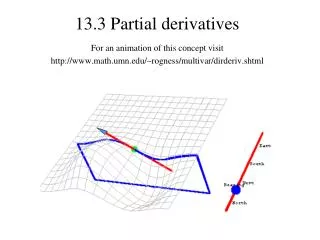
13.3 Partial derivativesFor an animation of this concept visithttp://www.math.umn.edu/~rogness/multivar/dirderiv.shtml
When we have functions with more than one variable, we can find partial derivatives by holding all the variables but one constant. z 100 10 y 10 x (eff sub ecks) Note: is also written as
would give you the slope of the tangent in the plane y=0 or in any plane with constant y. z 100 10 y 10 x In other words, how is changing one variable going to change the value of the function?
Definition of Partial Derivatives of a Function of Two Variables
Example 2 f(x,y) = e xy , find fx and fy And evaluate each at the point (1,ln2) 2
Example 3 Find the slope in the x-direction and in the y-direction of the surface given by When x=1 and y=2
Example 4 Find the slope of the given surface in the x-direction and the y-direction at the point (1,2,1)