
SlideServe
Menu
Préférences
© SlideServe · v2026

Section 1-4: Measuring Angles

amalie avatar
8 diapositives · 364 Views · Oct 22, 2014

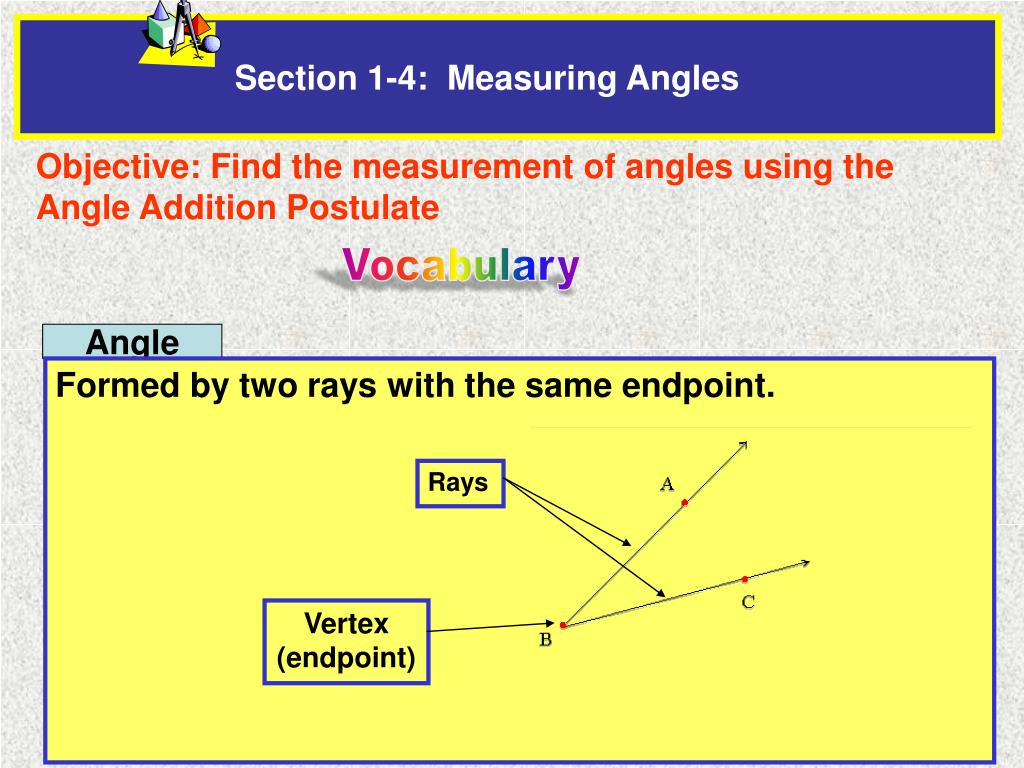
Section 1-4: Measuring Angles. Objective: Find the measurement of angles using the Angle Addition Postulate. Vocabulary. Angle. Formed by two rays with the same endpoint. Rays. Vertex (endpoint). Naming Angles. 1. Name the Rays of the angle:.
Section 1-4: Measuring Angles - slide 1
01 / 8Section 1-4: Measuring Angles
1 / 17

Télécharger la présentation

Section 1-4: Measuring Angles
Une image / un lien ci-dessous est fourni (tel quel) pour télécharger la présentation

Politique de téléchargement : le contenu du site vous est fourni TEL QUEL pour votre information et votre usage personnel ; il ne peut être vendu, concédé sous licence ni partagé sur d’autres sites sans l’accord de son auteur.Le contenu vous est fourni TEL QUEL, pour votre information et votre usage personnel uniquement. Téléchargez la présentation en cliquant sur ce lien. Lors du téléchargement, si vous ne parvenez pas à télécharger une présentation, l’éditeur a peut-être supprimé le fichier de son serveur.Pendant le téléchargement, si vous ne parvenez pas à obtenir une présentation, le fichier a peut-être été supprimé par l’éditeur.

F I N

Plus de contenu associé

Transcription de la présentation
  1. Section 1-4: Measuring Angles Objective: Find the measurement of angles using the Angle Addition Postulate Vocabulary Angle Formed by two rays with the same endpoint. Rays Vertex (endpoint)

  2. Naming Angles 1 Name the Rays of the angle: What is the vertex of the angle? Vertex is B • Different ways to name the angle: • Name by vertex: • Name by 3 points (vertex in middle): • Name by a number:

  3. Geometry is used to construct roofs. Use the diagram below to answer the following questions. G 1 2 H I F What is the vertex of the large angle? The vertex is G Name the Rays of the angle: Name all the angles in the diagram using both letters & numbers.

  4. Measuring Angles and the Protractor Postulate Protractor Postulate For every angle, there corresponds a number between 0 and 180º. This number is called the measure of the angle and is written in degrees. Postulate 1-7

  5. Four Different Classifications of Angles Right Angle Straight Angle Acute Angle Obtuse Angle

  6. Using a Protractor to Measure Angles 1. Place the vertex at zero on the protractor 2. Align one ray with the bottom edge of the protractor 3. Read measurement (in degrees) on protractor 4. Caution: Pay attention to the numbers Ensure answer makes sense What type of angle is represented in the diagram?

  7. Angle Addition Postulate Angle Addition Postulate Postulate 1-8 AXB and BXD form linear pairs and are adjacent angles G If the mDEG = 145º , find the mGEF. 35 145º + _____ = 180 D E F Name the adjacent angles? Are they a linear pair?

  8. m 1 + m 2 = m ABCAngle Addition Postulate. 42 + m 2 = 88Substitute 42 for m 1 and 88 for m ABC. m 2 = 46 Subtract 42 from each side. Think! Suppose that m 1 = 42 and m ABC = 88. Find m 2. What postulate do you use to solve the problem? Use the Angle Addition Postulate to solve.