Understanding Periodic Trends: Reactivity, Electronegativity, and Atomic Structure
This practice exercise delves into key concepts of periodic trends, including reactivity among metals, electronegativity, atomic radius, ionization energy, and valence electrons. Participants will analyze which elements from given groups have the least reactivity, highest electronegativity, largest atomic radius, and lowest ionization energy. The exercise also explores oxidation states and periodic classifications of elements. Ideal for anyone looking to solidify their understanding of atomic properties and the periodic table.

Understanding Periodic Trends: Reactivity, Electronegativity, and Atomic Structure
E N D
Presentation Transcript
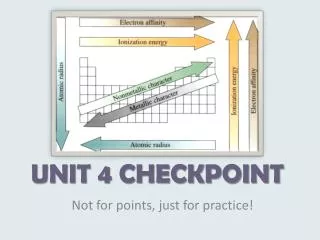
UNIT 4 CHECKPOINT Not for points, just for practice!
Which of the elements would be the least reactive metal? • 13-Aluminum • 14-Silicon • 17-Chlorine • 12- Magnesium • 16-Sulfur
Which element in period 4 will have the highest electronegativity? • Potassium • Calcium • Germanium • Selenium • Bromine
Which element in period 4 will have the largest atomic radius? • Potassium • Calcium • Germanium • Selenium • Bromine
Which element in period 4 will have the lowest ionization energy? • Potassium • Calcium • Germanium • Selenium • Bromine
Which element in period 4 will have 4 valence electrons? • Potassium • Calcium • Germanium • Selenium • Bromine
Which element in period 4 will have an oxidation number of 1-? • Potassium • Calcium • Germanium • Selenium • Bromine
Who proposed the theory that properties of elements are periodic functions of their atomic numbers? • Newlands • Dobereiner • Moseley • Mendeleev • Pehanic
32-Germanium is in what family of the periodic table? • Alkali Metals • Alkaline Earth Metals • Transition Metals • Inner Transition Metals • Post Transition Metals • Halogens • Noble Gases • Metalloids • Other Nonmetals
56-Barium is in what family of the periodic table? • Alkali Metals • Alkaline Earth Metals • Transition Metals • Inner Transition Metals • Post Transition Metals • Halogens • Noble Gases • Metalloids • Other Nonmetals
An atom of sodium has 11 protons, 12 neutrons, and 10 electrons. What is its mass number? • 21 • 22 • 23 • 22.989
37-Rubidium would have all of the following characteristics except? • High Conductivity • High Malleability • High Brittleness • Solid at Room Temperature • 1 Valence Electron
34-Selenium would have how many valence electrons? • 2 • 4 • 6 • 7 • 8
Which of the following is a nonmetal? • 3-Lithium • 16-Sulfur • 49-Indium • 51-Antimony • 58-Cerium
What is the oxidation number for 20-Calcium? • 1+ • 2+ • 6+ • 1- • 2- • 6-
Which element is most likely man-made (not naturally occurring)? • 5-Boron • 17-Chlorine • 38-Strontium • 46- Palladium • 95-Americium
How many valence electrons do the transition metals have? • One valence electron • Two valence electrons • Three valence electrons • Variable number of valence electrons • Zero valence electrons