Download
1 / 15
210 likes | 466 Vues
Explore the fundamentals of small group communication, leadership styles, group culture, roles, conflict management, and stages of group development. Learn how leaders emerge, maintain influence, and manage conflicts within small groups.

E N D
What is Small-Group Communication? 3-9 people Over 10 -Several members don’t participate -Sub-groups Ideal Group Size -4.6 people. (Hackman and Vidmar, 1970)
Small Group Functions Small Group Types • Task-oriented groups • Relationship-oriented groups • Assigned groups • Emergent groups
What is Leadership? A process of using communication to influence the behaviors and attitudes of others to meet group goals
Types of Leaders • Types of Small Group Leaders • Appointed leaders • Emergent leaders
How Leaders Emerge • Initiative • Rising to occasion • Expectations • Cultural norms • Experience/Position • Age • Gender • Personality
How Leaders Maintain • Reward • Punishment • Charisma • Trustworthiness • Skill • Knowledge
Leadership Styles • Democratic leaders • Laissez-faire leaders • Autocratic leaders
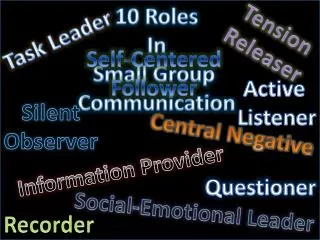
Group Culture • Norms • Informal rules for interaction • Member Roles • Formal Roles • Vice Presidents • Historian • Behavioral Roles • Task functions • Maintenance functions • Self-centered functions
Task Roles Accomplish goals Examples of Task Roles 1. Leader - helps the group define and achieve goals.2. Initiator - contributor: Offers ideas and suggestions.3. Opinion seeker – requests info4. Information giver5. Secretary – recorder6. Devil’s advocate – prevents “group think” 7. Worker Bee – ready to follow
Maintenance Roles Maintain morale Examples of Maintenance roles 1. Encourager – provides emotional warmth, praise and acceptance2. Harmonizer – help people connect and help resolve social conflicts3. Feeling Expresser – monitors feelings and moods of the group and gives feedback. 4. Morale Builder – maintains positivity through socializing and outlook.
Self-Serving Roles Negatively affect group Examples of Self-Serving Roles1. Stagehog – recognition seeker2. Isolate – withdraws from the group3. Clown – horseplay, practical jokes, comic routines that goes beyond tension reliever.4. Blocker/Cynic – opposes everything new/displays sour outlook5. Fighter – starts arguments, bullying.
Stages of Group Development • The group knows its purpose and roles well and it’s nearly 2nd nature. • Normal behaviors are starting • Conflict over purpose, leadership, roles, norms • Awkward • No clear leaders or rolesd
Group Pros and Cons Pros - More ideas = Better ideas • Can speed process up • Unity, Accountability Cons • More ideas = Standstill • Can slow process down • Groupthink