Understanding the Human Muscular System: Functions, Types, and Major Muscles
The human muscular system comprises 650 muscles, crucial for body movement, shape, heat production, and maintaining body temperature. Muscles are classified into three types: skeletal (voluntary), smooth (involuntary), and cardiac (heart). Skeletal muscles have a striated appearance and fatigue easily, while smooth muscles control organs and are more enduring. Major muscles like the biceps, triceps, and gluteus maximus play vital roles in movement. This overview explores muscle characteristics such as contractibility, excitability, extensibility, and elasticity.

Understanding the Human Muscular System: Functions, Types, and Major Muscles
E N D
Presentation Transcript
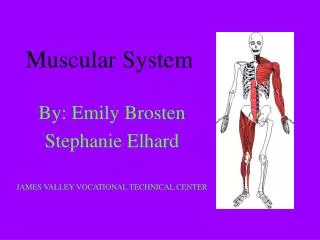
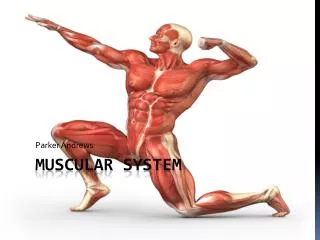
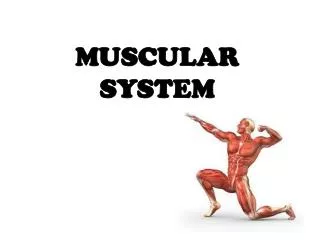
Muscular System The Power System
Functions • There are 650 muscles in the human body and they do the following: • Responsible for all body movement • Responsible for body form and shape (posture) • Produce body heat and maintain body temperature Did you know that nearly half our weight comes from muscle tissue?
Types of Muscles • Skeletal • Smooth • Cardiac
Skeletal Muscle • Attached to bone • Striated (striped) appearance • VOLUNTARY (can move when you want to) • Multinucleated muscle cell bundles (muscle cells = muscle fibers) • SARCOLEMMA = cell membrane • Contract quickly, fatigue easily, can’t maintain contraction for long period of time
Smooth muscle • Visceral (organ) muscle • Found in walls of digestive system, uterus and blood vessels • Cells small and spindle-shaped • INVOLUNTARY • Controlled by autonomic nervous system • Act slowly, do not tire easily, can remain contracted for long time
Cardiac Muscle • Found only in the heart • Striated and branched • Involuntary • Cells are fused – when one contracts, they all contract • Involuntary
Sphincter Muscles special circular muscles in openings of esophagus and stomach, and small intestine, anus, urethra and mouth.
Characteristics of Muscles • CONTRACTIBILITY – the ability of a muscle to reduce the distance between the parts of its contents or the space it surrounds. • EXCITEABILITY (IRRITABILITY) – the ability to respond to certain stimuli by producing impulses. • EXTENSIBILITY – the ability to be stretched. • ELASTICITY – ability of muscle to return to its original length when relaxing.
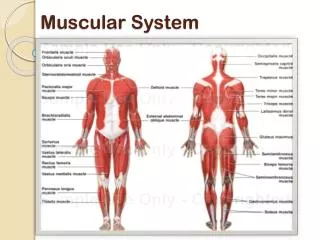
Major Muscles of the Body • Sternocleidomastoid—side of neck—turns and flexes head • Trapezius—Upper back and neck—turns head and moves shoulder • Deltoid—shoulder—abducts arm at shoulder and injection site • Biceps brachii—upper arm—flexes lower arm • Triceps brachii—back of upper arm—extends lower arm
More muscles • Pectoralis Major—upper chest—adducts upper arm • Intercostals—between ribs—moves ribs for breathing • Rectus abdominus– ribs to pelvis—compresses abdomen • Latissimusdorsi—lower back—extends and adducts upper arm
More Muscles • Gluteus maximus—buttocks—extends thigh—injection site • Sartorius—front of thigh—abducts thigh, flexes leg • Quadriceps femoris—front of thigh—extends leg • Hamstrings—back of thigh • Gastrocnemius—calf muscle—flexes sole of foot