Understanding Market Structures: Concepts, Shutdown Rule, and Oligopoly Dynamics
This article delves into the fundamental concepts of market structures, focusing on the shutdown rule, profit-maximizing quantity (where MC = MR), and market power. It covers key factors influencing market structure, such as the number of buyers and sellers, barriers to entry and exit, and regulations. Additionally, the characteristics of oligopoly are explored, including strategic behavior, the prisoner's dilemma, collusion, and the dynamics of competition within oligopolistic markets. Gain insights into how these elements shape economic performance.

Understanding Market Structures: Concepts, Shutdown Rule, and Oligopoly Dynamics
E N D
Presentation Transcript
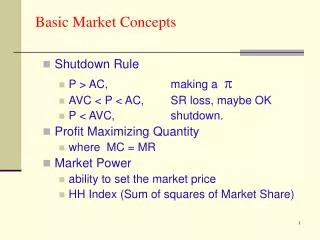
Basic Market Concepts • Shutdown Rule • P > AC, making a • AVC < P < AC, SR loss, maybe OK • P < AVC, shutdown. • Profit Maximizing Quantity • where MC = MR • Market Power • ability to set the market price • HH Index (Sum of squares of Market Share)
Factors that determine Market Structure • Number of Buyers and Sellers • Barriers to Entry / Exit • Regulation (patent etc.) • Sole Ownership • Scale Economies (Natural Monopolies) • Are the Products Homogenous / Differentiated
Oligopoly: Strategic Behavior • Barriers to entry that can lead to oligopoly. • The prisoner’s dilemma model. • Game theory analyzes behavior of oligopolists. • Equilibrium may differ in games • with repeated plays • played only once. • Explicit and implicit collusion. • Why and when cheating is likely in a cartel. • Forces operating to restrict and reduce the extent of oligopoly in the economy.