Enhanced Hurricane Wind Speed Retrieval Using Advanced QuikSCAT OVW Techniques
This paper presents a novel retrieval technique for Ocean Vector Winds (OVW) using QuikSCAT data, particularly in hurricane scenarios. The newly developed X-Winds algorithm significantly improves wind speed estimates, which are found to be approximately 10 m/s higher than the standard L2B product. The method employs a specialized Geophysical Model Function (GMF) to address issues related to rain contamination and inadequate spatial resolution. Comparisons indicate that this approach yields better results than conventional methods, offering essential data for tropical and extra-tropical cyclone studies.

Enhanced Hurricane Wind Speed Retrieval Using Advanced QuikSCAT OVW Techniques
E N D
Presentation Transcript
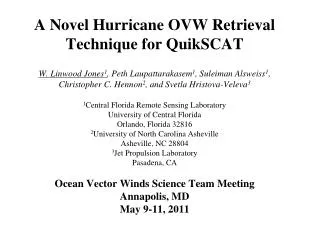
A Novel Hurricane OVW RetrievalTechnique for QuikSCATW. Linwood Jones1, Peth Laupattarakasem1, Suleiman Alsweiss1, Christopher C. Hennon2, and Svetla Hristova-Veleva31Central Florida Remote Sensing LaboratoryUniversity of Central FloridaOrlando, Florida 328162University of North Carolina AshevilleAsheville, NC 288043Jet Propulsion LaboratoryPasadena, CAOcean Vector Winds Science Team MeetingAnnapolis, MDMay 9-11, 2011
Outline • SeaWinds OVW measurements in hurricanes • Radar backscatter geophysical model function • X-Winds OVW retrieval algorithm • wind direction retrieval • wind speed retrieval • X-Wind Comparisons with H*Wind
SeaWinds Hurricane OVW Measurements • Historically Ku-band scatterometers have consistently under estimated hurricane wind speeds • Issues • Inadequate spatial resolution • Rain contamination • Geophysical OVW algorithms • GMF – relationship between radar backscatter and surface wind speed • Rain correction
Extreme Winds Sigma-0 Geophys Model Function (XW-GMF) • Special GMF developed for hurricanes • Training dataset of 35 QScat hurricane overpasses • 3-D GMF: so = f(ws, relative wdir, atmos transmis) • WS: one-minute sustained 10m wind speeds from NOAA HRD H*Wind surface wind analysis • Relative wind direction c:from multi-radar az looks and from H*Wind analysis • Atmos transmissivity: inferred from simultaneous observations of QRad H-pol brightness temperatures
Hurricane Geophysical Model Function (GMF)QuikSCAT H-pol, 30 m/s so , dB
GMF C0 Coeff Dependence on Wind Speed C0 , dB 10 20 40 60 Wind Speed, m/s
GMF Anisotropy with Wind Speed C1 , linear units C2 , linear units 10 20 40 60 Wind Speed, m/s 10 20 40 60 Wind Speed, m/s
XW-GMF Atmospheric Transmissivity • Rain attenuation is corrected implicitly through use of the QRad H-pol brightness temperature Tbh • GMF = f(ws,rel_wdir, Tbh) Tbh
X-Winds OVW retrieval Algorithm • Attributes • Assumes cyclonic wind direction rotation about TC center • Assumes rain effects are primarily absorptive • Rain volume backscatter is neglected • Empirical 3-D XW-GMF accounts for backscatter saturation with wind speed & rain absorption • Uses scalar wind direction and wind speed estimation • Not traditional maximum likelihood estimation
Scalar Wind Direction Estimation • Relies on anisotropy of measured difference between forward and aft looking backscatter measurements Dsomeas = (sofore – soaft) @ top-of-the-atmos Latitude Index Dso - linear units Longitude Index
Wind Direction Modeling of Dso Sigma-0 anisotropy model for single radar azimuth look Taking the difference between fore & aft radar looks yields Wind direction solutions (aliases) are roots of Yields ambiguous wind direction solutions typically ~ 6 – 8
Wind Direction Alias Removal • Keep ambiguities within window ±30 from CCW spiral • Multi-pass median filter and populate missing pixels through interpolation • Use smoothed TC wind field for wind speed estimation Wind Directions Ambiguities Initial Wind Direction Field
X-Winds Scalar Wind Speed Estimation • Use smooth TC wind field as “estimated true” wind direction and calculate relative wind direction c = (radar az – “est-wind dir”) • Find 1-D wind speed solution for each so flavor (pol & direction) that satisfies this relationship
X-Winds Wind Speeds Retrievals (4- so flavors) HF HA VF VA Wind Speed (m/s)
- L2B-12.5km OVW product- H*Wind surface wind analysis X-Winds Comparisons
Hurricane Fabian Rev#21898 X-Winds Previous Q-Winds H*Wind L2B-WS 12.5km
Hurricane Ivan Rev#27217 X-Winds Previous Q-Winds H*Wind L2B-WS 12.5km
Wind Speeds Comparison (10 revs) X-Winds QuikSCAT L2B-12.5km TbH-pol TbH-pol
Wind Direction Comparison (10 revs) X-Winds QuikSCAT L2B-12.5km TbH-pol TbH-pol
Conclusion • A new OVW retrieval algorithm has been developed for SeaWinds • Specifically tailored to to tropical and extra-tropical cyclones • Retrieves wind speeds that are approx 10 m/s higher than the standard L2B-12.5km OVW product • Performs better in comparison with H*Wind surface wind analyses • A new L-3 SeaWinds TC OVW data set will be produced starting this summer 2011