Enhancing File Transfer in Mesh Networks through Location-Based Querying
50 likes | 166 Vues
In a scenario involving a mobile user seeking a media file, the user connects to a mesh network and learns that another station possesses the desired file. By querying the location of the other station, the user can move closer, facilitating the establishment of a direct, high-speed link for efficient file transfer. The privacy of users is preserved as individual identities and precise locations are not disclosed; only a directional vector is utilized for enhancing throughput. Proposed modifications to frame formats aim to support this location-based functionality.


Enhancing File Transfer in Mesh Networks through Location-Based Querying
E N D
Presentation Transcript
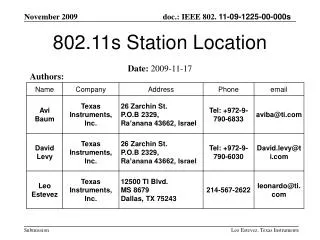
802.11s Station Location Date: 2009-11-17 Authors: Leo Estevez, Texas Instruments
Use Case/Motivation • A mobile user looking for a media file of interest joins a mesh network and learns that someone else in the mesh has a desired file. The mobile user queries for the other station’s location in order to move closer to it and establish a direct high speed link for file transfer. Leo Estevez, Texas Instruments
Frame Exchange Leo Estevez, Texas Instruments
Privacy Considerations • The identity of the person is not disclosed and an exact location need not be disclosed since the location information is just used to establish a directional vector intended to enable throughput enhancement of the desired file. Leo Estevez, Texas Instruments
Required Modifications • Frame Formats (section 7.3) • Modify paragraph 7.3.2.66.10: Location Descriptor sub-element: • In the Location request frame, the Location Descriptor field indicates whether the STA is requesting the Local Location, Remote Location or Remote AP Location, as shown in Table v28. • Add new line to Table v28 – Location Descriptor Bits 0-3 Description • 2: Remote STA Location: location of the STA connected to the AP • 3-15: Reserved • Capabilities field (7.3.2.31) • Add new capability bit: Remote STA location (dot11MgmtOptionSTALocationEnabled) Leo Estevez, Texas Instruments