Download

1 / 10
100 likes | 235 Vues
This overview explores the diverse economies of New England and the Middle Colonies, highlighting agricultural practices such as subsistence farming and the importance of fishing, whaling, and lumbering. It details the significant role of towns and Puritan society in daily life and governance, alongside the impact of triangular trade routes. Additionally, the description covers the wheat boom in the Middle Colonies, leading to urban growth in cities like New York and Philadelphia, and discusses social classes shaped by trade and agriculture.

E N D
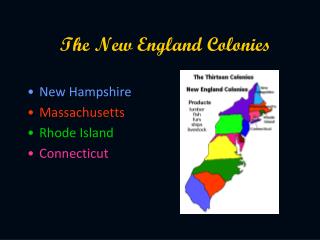
Farming • NE had diverse economy • Small, subsistence farms • Farmers used what they grew
Fishing & Whaling • Fishing a major industry • Grand Banks- area of Atlantic with abundant fish • Grand Banks just north of NE
Lumbering & Shipbuilding • Geographically, NE is good for lumbering • Mountains are close to coast- means many streams • Makes sawmills plentiful • A lumbering industry + good harbors= shipbuilding as a major industry
Government • Life centered on church (Puritans) • Good Christians encouraged towns • Towns very important • Common people participated in government • Town ruled via town meeting • First, everyone comes, then elect officials to represent them
Puritan Society • Puritan homes located near church (meetinghouse) • Strict, rigid rules were enforced • However, Puritans did have fun (bright clothes, played games)
Triangular Trade • NE produces little goods • Resident want goods from England • Leads to merchants • NE traded fish & lumber with Caribbean planters for sugar • Either got sugar or bills of exchange • Buy English goods with sugar • Sell English goods for fish & lumber • Another Triangular trade: • NE gives rum to W. Africans for slaves • Slaves to Caribbean for sugar • Sugar to NE for lumber (makes rum)
New Urban Society • Increase in trade makes port cities grow • Upper class of the city are merchant (small portion)-controlled trade • Middle are artisans (skilled workers) and shopkeepers (50%) • Next- unskilled labor (dock workers, etc (30%) • Lowest social class- indentured servants then slaves (not a social class)- about- 10-20%
Growth of the Middle Colonies • Main crop wheat- sold to Caribbean • Good, wide, deep rivers made shipping to coast easy • Shipping made New York & Philadelphia largest cities in English colonies
The Wheat Boom • Early 1700s- population boom in middle colonies (still had land available) • Wheat boom + cheap, poor labor force made some wealthy • New wealth produced new capital to invest in industry • Very few farmers got rich (mainly due to technology)