The Ancient West
170 likes | 298 Vues
Explore the roots of Western religions in the Ancient West, focusing on Zoroastrianism in Persia, ancient Greek polytheism, and Roman numina. Zoroastrianism, founded by Zoroaster over 3,500 years ago, was a dominant monotheistic faith that emphasized the battle between good and evil through the worship of Ahura Mazda. Ancient Greece's pantheon featured gods like Zeus and Hera, reflecting humanity's virtues and flaws, while Roman religion involved supernatural powers known as numina. Delve into the mystical and ethical dimensions of these early religious traditions.


The Ancient West
E N D
Presentation Transcript
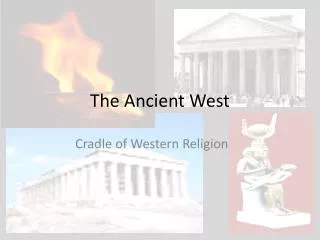
The Ancient West Cradle of Western Religions
Early Western Religious Traditions • Ancient Iran (Persia) • Zoroastrianism • Ancient Greece • Homer • Pantheon of gods • Mystery religions • Ancient Rome • Pantheon of gods • Mystery religions
Zoroastrianism • Zoroastrianism is one of the world's oldest monotheistic religions. It was founded by the Prophet Zoroaster(or Zarathustra) in ancient Iran approximately 3500 years ago. • For 1000 years Zoroastrianism was one of the most powerful religions in the world. It was the official religion of Persia (Iran) from 600 BCE to 650 CE. • It is now one of the world's smallest religions. In 2006 the New York Times reported that there were probably less than 190,000 followers worldwide at that time. • Zoroastrians are roughly split into two groups: • The Iranians • The Parsis • The Zoroastrian book of Holy Scriptures is called The Avesta.
FYI The Magi of the Nativity King Cyrus of Persia
The Prophet Zarathustra • AKA Zoroaster • Visited by an angel, Good Thought, and brought to Ahura Mazda • Began to teach the radical idea of monotheism • Died at 77 years old • 17 hymns, Gathas, attributed to him. These are the oldest teachings in the Avesta
Ahura Mazda • Zoroastrians believe there is one God called Ahura Mazda (Wise Lord) and He created the world. • Ahura Mazda revealed the truth through the Prophet, Zoroaster who claimed him as the one true god • Ahura Mazda is eternal and universal goodness, and controls the cosmos and the destiny of human beings
Worship • Zoroastrians are not fire-worshippers, as some Westerners wrongly believe. Zoroastrians believe that the elements are pure and that fire represents God's light or wisdom. • Zoroastrians traditionally pray five times a day. • Zoroastrians worship communally in a Fire Temple or Agiary.
The Avesta • The Avesta can be roughly split into two main sections: • The Avesta is the oldest and core part of the scriptures, which contains the Gathas. The Gathas are seventeen hymns thought to be composed by Zoroaster himself. • The Younger Avesta - commentaries to the older Avestawritten in later years. It also contains myths, stories and details of ritual observances.
Ethical Dualism • Universal forces of good and evil, the most distinctive feature of Zoroastrianism • If evil exists, how is Ahura Mazda the only god? • Twins, a beneficent spirit and a hostile spirit. • Free will • Truth vs. Lie (Shaitan) • Hint of a future savior that would restore goodness to world • Great care should be taken to avoid those on the side of evil • Agricultural life, ethics within that life
Beliefs • Monotheism • “Great requital” (final judgment) • Worst existence • House of best purpose • Individual responsibility • Resurrection
Modern Zoroastrianism • Adherents live predominately in India, called Parsis • Few are in Iran • Maintain reverence for Zarathustra, and the Avesta • Dead left on mountain to be eaten by vultures • Closed society, do not accept new converts • Marriage outside of their faith is denounced • Share wealth with those in need
Religion in Ancient Greece • Homer • Illiad & Odessey • The “Bible” of ancient Greece • Polytheistic • Gods and goddesses live in Olympus as a loose-knit family • Zeus & Hera • Various other gods in control of different aspects of nature or life • Anthropomorphic – having human attributes • All gods and goddesses have specific talents and limitations • Moral behavior is human like • Zeus and Hera quarrel • Ares and Aphrodite commit adultery • Greek dramatists • Wrote plays depicting the justice, power and moral principles of the deities
Practices of Ancient Greeks • Piety & Worship • Prayers and worship brought favorable response from deities, conversely, punishment came to the impious • Sacrifices were appreciated by the gods and protection was offered to the gift giver • Festivals • Local events honoring local deities • Olympic games to honor Zeus • Oracles • Term used to identify the place, person and message • Oracle at Delphi • Death & Afterlife • Gloomy and dark in Hades across the River Styx • Elysian fields- Paradise
Mystery Religions of Greece • Eleusian mysteries Demeter & Persephone Agricultural cycle • Cult of Dionysus Vegetation, fertility and wine Turned water into wine Ecstatic and untamed worship • A diverse group of beliefs and practices of the ancient Greek and Roman civilization that included • Initiation • Personal encounter • Hope for spiritual renewal and afterlife • Orphism • Body- evil, soul- good • Vegetarian • Hope to escape the body • reincarnation • Cult of Asciepius • Healing cult • Daughter, Hygeia
Religion in Ancient Rome • Numina • Those having supernatural powers (numen) • Roman thought toward their gods was not human as it was for the Greeks • By observance of ritual toward the god favors would be granted • Roman Gods & Goddesses • Counterparts of the Greek gods • Zeus>Jupiter • Hera> Juno
Mystery Religions of Rome • Emperor worship • Worship of the emperor began with the Greek Alexander the Great • Julius Caesar flirted with the idea • Caligula and Nero declared their divinity • Caesar Augustus encouraged worship of his genius or spirit • Christian persecution was a result of this practice • Cult of Isis • Ancient tradition from Egypt regarding Isis and Osiris • Initiation leads to rebirth • Images of Isis and her son Horus influenced the images of Mary and Jesus • Christianity • New secret religion