Empirical Formula
This guide provides an overview of empirical formulas, essential for understanding the composition of chemical compounds. It explains how to derive these formulas from percentage composition data, with examples involving compounds containing elements like calcium, nitrogen, oxygen, and more. Learn to convert percentages into grams, then moles, and calculate ratios to find the empirical formula. With practical examples, including compounds such as Na, Cr, and O, this resource is ideal for students and enthusiasts eager to grasp chemical composition analysis.

Empirical Formula
E N D
Presentation Transcript
Empirical Formula • Agenda • Check % composition • Review naming • Review mole Town
24.4% Ca, 17.1% N, 58.5% O 50.8% Zn, 16.1%P, 33.1%O 108.5 g Fe 404.6 lb Al 3.9 g H 43.5 kg Ag 173.2 lb Pb 56.8 g H2O % composition
Review Naming • Al2O3 • PbO2 • BCl3 • Ca+2 • F- • (NH4)3PO4 • H2Cr2O7
Empirical Formula Date:
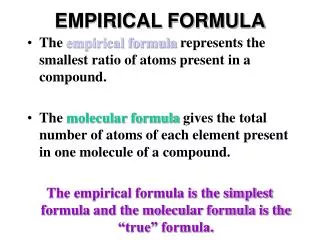
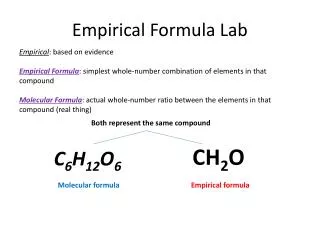
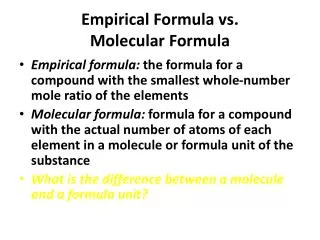
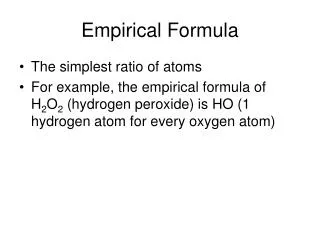
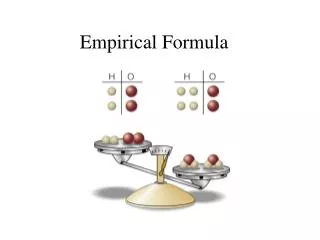
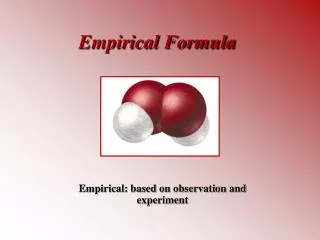
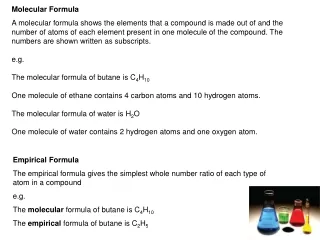
Empirical Formula • Definition: Most reduced formula; provides the ratio of one atom to an other. • Fe+2 and O-2
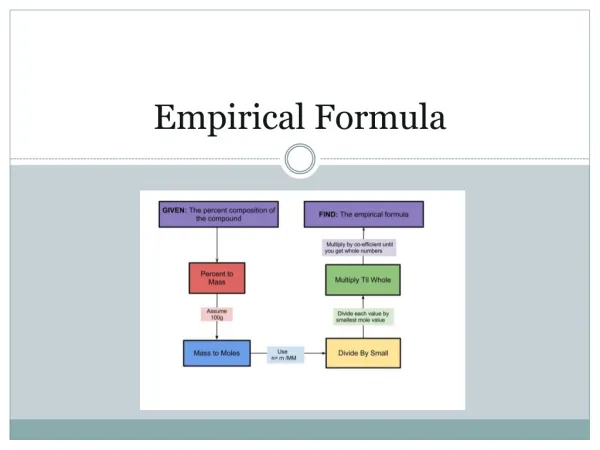
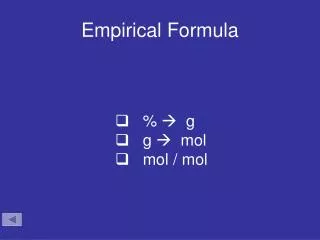
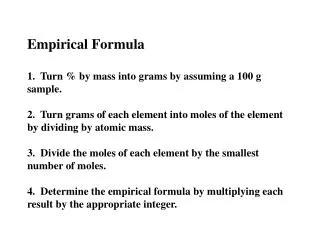
Using % comp to find EF • Assume one has 100 g • Change %’s into grams • Convert g to moles using Mole Town • Divide by atomic mass • Divide all number of moles by the smallest • Provides ratio of one to another
Determine the EF of a compound that is 17.5% Na, 39.7% Cr, and 42.8%O.