Objects in ASP
This article provides a comprehensive overview of three essential ASP objects: Response, Request, and Application. The ASP.Response object is utilized for sending output from the server to the user, featuring various collections, properties, and methods. The Request object is employed to retrieve information from visitors, facilitating dynamic content delivery. Meanwhile, the Application object connects multiple ASP files, allowing for shared variables and centralized information access. Learn how these objects interact to enhance ASP application functionality.

Objects in ASP
E N D
Presentation Transcript
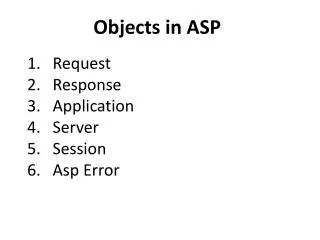
Request Response Application Server Session Asp Error Objects in ASP
Response Object The ASP Response object is used to send output to the user from the server. Its collections, properties, and methods are described below: Collections
Request object When a browser asks for a page from a server, it is called a request. The Request object is used to get information from a visitor. Its collections, properties, and methods are described below:
Methods Request Object
APPLICATION OBJECT • An application on the Web may consists of several ASP files that work together to perform some purpose. The Application object is used to tie these files together. • The Application object is used to store and access variables from any page, just like the Session object. The difference is that ALL users share ONE Application object (with Sessions there is ONE Session object for EACH user). • The Application object holds information that will be used by many pages in the application (like database connection information). The information can be accessed from any page. The information can also be changed in one place, and the changes will automatically be reflected on all pages
Events APPLICATION OBJECT