Download
1 / 10
100 likes | 225 Vues
Non-specific immunity comprises various internal defenses that protect the body against pathogens. This includes antimicrobial proteins like interferons and complement proteins, which hinder microbial growth and enhance immune responses. Natural killer (NK) cells play a crucial role in targeting abnormal cells, while phagocytes, including neutrophils and macrophages, ingest and destroy microbes through phagocytosis. Inflammation marks the response to tissue damage, characterized by redness, heat, swelling, and pain, aiding in trapping pathogens and initiating repair. Fever also plays a role by inhibiting bacterial growth and enhancing recovery.

E N D
Non Specific Immunity: Internal Defenses • Antimicrobial Proteins • Natural Killer Cells • Phagoctyes • Inflammation • Fever Tortora & Grabowski 9/e 2000 JWS
Internal Defenses • Antimicrobial proteins discourage microbial growth • interferons • produced by virally infected lymphocytes & macrophages • diffuse to neighboring cells to induce synthesis of antiviral proteins • complement proteins • when activated enhance immune, allergic & inflammatory reactions • transferrins • iron-binding proteins inhibit bacterial growth by reducing available iron Tortora & Grabowski 9/e 2000 JWS
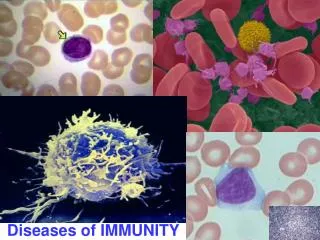
Natural Killer Cells & Phagocytes • NK cells kill a variety of microbes & tumor cells • found in blood, spleen, lymph nodes & red marrow • attack cells displaying abnormal antigens • Phagocytes (neutrophils & macrophages) • ingest microbes or particulate matter • macrophages developed from monocytes • fixed macrophages stand guard in specific tissues • wandering macrophages in most tissue Tortora & Grabowski 9/e 2000 JWS
Phagocytosis • Chemotaxis • attraction to chemicals from site of damage • Adherence • attachment to plasma membrane of phagocyte • Ingestion • engulf by pseudopods to form phagosome • Digestion & killing • merge with lysosome containing digestive enzymes & form lethal oxidants • exocytosis residual body Tortora & Grabowski 9/e 2000 JWS
Inflammation • Damaged cell initiates • Signs of inflammation • redness • heat • swelling • pain • Function is to trap microbes, toxins or foreign material & begin tissue repair Tortora & Grabowski 9/e 2000 JWS
Stages of Inflammation • Vasodilation & increased permeability of vessels • occurs within minutes producing heat, redness & edema • pain can result from injury, pressure from edema or irritation by toxic chemicals from organisms • blood-clotting factors leak into tissues trapping microbes • Phagocyte emigration • within an hour, neutrophils and then monocytes arrive and leave blood stream (emigration) • Tissue repair Tortora & Grabowski 9/e 2000 JWS
Abscesses and Ulcers • Pus - dead phagocytes, damaged tissue cells & fluid • Abscess - accumulation of pus in a confined space not open to the outside • pimples & boils • Ulcer is an open sore Tortora & Grabowski 9/e 2000 JWS
Fever • Occurs during infection & inflammation • bacterial toxins trigger release of fever-causing proteins • Benefits • intensifies effects of interferons, inhibits bacterial growth, speeds up tissue repair Tortora & Grabowski 9/e 2000 JWS
Specific Resistance: Immunity • Immunity is bodies ability to defend itself against specific foreign material or organisms • bacteria, toxins, viruses, cat dander, etc. • Differs from nonspecific defense mechanisms • specificity----recognize self & non-self • memory----2nd encounter produces even more vigorous response Tortora & Grabowski 9/e 2000 JWS
STOP!!! • Your quiz next class will cover the notes you just took…you need to make sure you READ and study them. Don’t just write them and think you’re done! Tortora & Grabowski 9/e 2000 JWS