Understanding the Cell Cycle: The Puzzle of Growth and Repair
Explore the phases of the cell cycle - Interphase, Mitosis, Cytokinesis. Learn how cells replicate and divide to create identical body cells for growth and repair. Discover the impact of abnormal changes in cell cycle leading to cancer.

Understanding the Cell Cycle: The Puzzle of Growth and Repair
E N D
Presentation Transcript
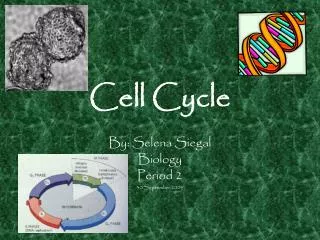
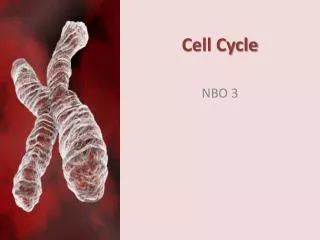
Pieces of the puzzle… Cell Cycle
The Goal • To make an identical body cell. • For growth or repair! http://www.msnbc.msn.com/id/12136506/
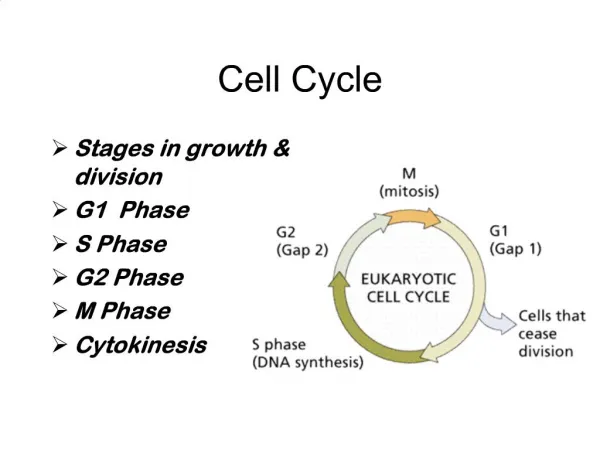
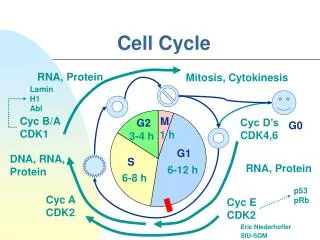
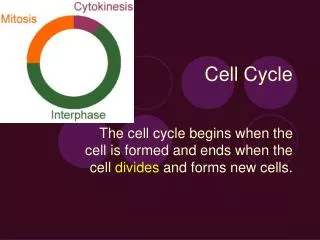
Interphase http://www.lima.ohio-state.edu/biology/images/interphase.jpg http://botit.botany.wisc.edu/images/130/Mitosis/Allium_Root_Prep._Slides/interphase.low.jpg Cells go through a life cycle known as the cell cycle. The phases of the cell cycle are interphase, mitosis, and cytokinesis. Mitosis Cytokinesis http://www.biologyreference.com/images/biol_01_img0100.jpg
1. Interphase What’s Happening in the cell: • G1: initial growth • S: DNA Replication • G2: organelles are made I-PMAT “Inter” – between – you drive on the interstate to go between MD and VA
2. Prophase What’s Happening in the cell: • Centrioles appear • Nucleus Splits • Chromosomes Pair I-PMAT
3. Metaphase What’s Happening in the cell: • Centrioles move to opposite ends • Chromosomes line up • in the middle • c. Spindle fibers begin to form I-PMAT
4. Anaphase What’s Happening in the cell: • Chromosomes pull apart and move to opposite ends of the cell I-PMAT
5. Telophase What’s Happening in the cell: • Telo = End • Two new nuclei form • Chromosomes • unravel I-PMAT
6. Cytokinesis What’s Happening in the cell: • Cell membrane moves inward to create two daughter cells • each daughter cell has its own nucleus with identical chromosomes Cyto = Cell Kinetic = movement
Interesting Factoids • Asexual reproduction gone awry is CANCER • Heredity, certain chemicals, and radiation can cause abnormal changes to a cell. The result can be growth and spread of abnormal cells throughout an organism.
Interesting Factoids • Abnormal growths, or tumors can be benign or malignant. • Malignant cells may break free and migrate to new locations to form a new tumor. • Cancer is not disorganized cell growth. It is a process by which certain cells acquire abnormal size, shape, and abilities. • The spread of malignant cells to new locations is known as cancer.