Download
1 / 1
10 likes | 175 Vues
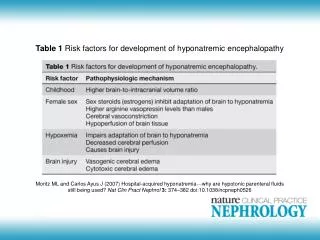
This article by Moritz ML and Carlos Ayus discusses the key risk factors that can lead to the development of hyponatremic encephalopathy, particularly in hospitalized patients. It critically examines the continued use of hypotonic parenteral fluids in clinical practice, highlighting the implications this has for patient safety and care. The authors provide insights into the pathophysiology of hyponatremia and its potential neurological consequences, emphasizing the importance of appropriate fluid management in preventing this serious condition.

E N D
Table 1 Risk factors for development of hyponatremic encephalopathy Moritz ML and Carlos Ayus J (2007) Hospital-acquired hyponatremia—why are hypotonic parenteral fluids still being used? Nat Clin Pract Nephrol3: 374–382 doi:10.1038/ncpneph0526