Download
1 / 14
140 likes | 262 Vues
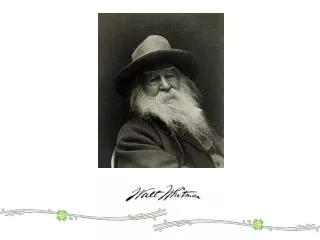
Explore the life and works of Walt Whitman, a pivotal figure in American literature and transcendentalism. From his early years as a printer to his role as a passionate nurse during the Civil War, Whitman's journey reflects a deep connection between the poet and society. His seminal work, “Leaves of Grass,” redefined poetry, celebrating democracy and the human experience. Discover how his writings, filled with vivid imagery and emotional depth, responded to the social anxieties of his time and asserted the importance of individuality and nature.

E N D
There is a Power whose care Teaches thy way along that pathless coast— The desert and illimitable air— Lone wandering, but not lost.
Nature Walden Transcendentalism
Whitman believed there was a vital, symbiotic relationship between the poet and society.
General Lafayette Brooklyn
1830 1834 1835 ~1838 1839 1840~1847 1848 1850~1855 Ended school An office boy in law firm Stayed in Brooklyn A journeyman printer A small town school teacher Rejoined his family Went back to NY A founder of Long Islander An editor for different newspapers Leaved NY, Traveled A stroller
1830 1834 1835 ~1838 1839 1840~1847 1848 1850~1855
1850~1855 During these half-decade he wrote and printed the first edition of his Leaves of Grass and thereby created a new epoch not only in American but also in world literature.
The pure contralto sings in the organloft, The carpenter dresses his plank ... the tongue of his foreplane whistles its wild ascending lisp, The married and unmarried children ride home to their Thanksgiving dinner, The pilot seizes the king-pin, he heaves down with a strong arm, The mate stands braced in the whale boat, lance and harpoon are ready, The duck-shooter walks by silent and cautious stretches, The deacons are ordained with crossed hands at the altar, The spinning girl retreats and advances to the hum of the big wheel Song of Myself
1. Whitman’s poetry resoponded to the more general social anxiety over the break-up of the Union. 2. As the American Civil War was beginning, Whitman published his poem “Beat Beat Dums!” as a patriotic rally call for the North. 3. Whitman, profoundly affected by seeing the wounded soldiers and the heaps of their amputated limbs. 4. In Washington, D.C., Whitman volunteered as a nurse in the army hospitals. Battle of Gettysburg
America Centre of equal daughters, equal sons, All, all alike endear’d grown, ungrown, young or old, Strong, ample, fair, enduring, capable, rich, Perennial with the Earth, with Freedom, Law and Love, A grand, sane, towering, seated mother, Chair’d in the adamant of time.