Download
1 / 16
160 likes | 280 Vues
This project presents the development of an A.S.WN.T.-based nanocompass designed for high spatial resolution magnetometry, crucial for applications in space magnetometry and planetary exploration. The presentation covers the project's motivation, fabrication processes including chemical vapor deposition (CVD) of single-walled carbon nanotubes (SWCNTs), and device operation. Key results include the successful measurement of magnetic fields, collaboration outcomes, and innovations in growing SWCNTs. The project emphasizes the importance of refined growth processes and rapid device fabrication using advanced lithography.

E N D
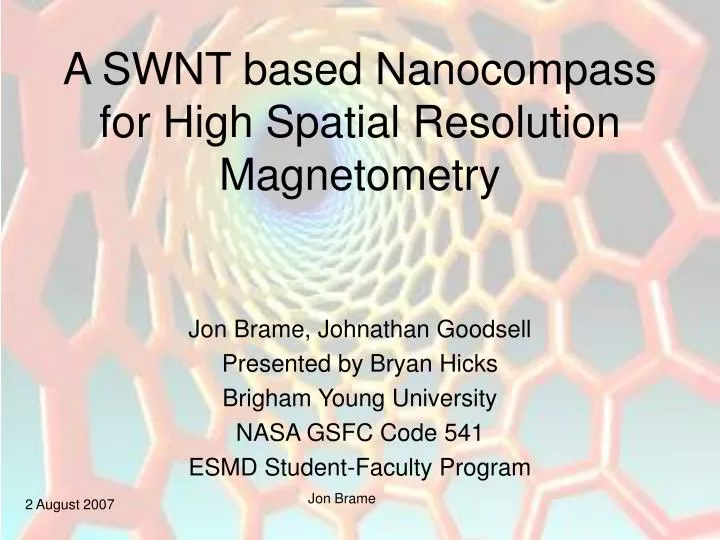
A SWNT based Nanocompass for High Spatial Resolution Magnetometry Jon Brame, Johnathan Goodsell Presented by Bryan Hicks Brigham Young University NASA GSFC Code 541 ESMD Student-Faculty Program Jon Brame
Overview • Project Motivation and Goal • Fabrication Process • Outcomes Jon Brame
CNT Properties • Change in Conductivity with Strain • Tombler, et al (Nature, 2000) • Single tube Jon Brame
CNT Properties • Change in Conductivity with Strain • Tombler, et al (Nature, 2000) • Single tube Jon Brame
Motivation • Space Magnetometry • Spacecraft Orientation • Magnetic Field Studies • Planetary Exploration • Astronaut/Rover Orientation • Planetary Geology Jon Brame
Device Operation Jon Brame
Prototype Jon Brame
Vacuum Chamber for Thin Film Deposition Process: Catalyst • Indirect Iron Catalyst Deposition Jon Brame
CVD Growth Furnace Diagram of CVD Growth Process SEM Image of SWCNT Mat Process: SWCNT Growth • Chemical Vapor Deposition (CVD) SWCNT Growth Jon Brame
Process – Electrical Contact • Gold Contact Pads • Detector Development Lab (DDL) • E-Beam Lithography • Deposition: Chrome(100Å)-Gold(1000Å) • Lift-off Jon Brame
Diagram of SWCNT network, contact pads and iron needle Process – Iron Needle • Iron Needle • Device Alignment • E-Beam Lithography pattern • Deposition: Chrome-Iron-Chrome • Lift-off Jon Brame
Au SWCNTs Remnant needle Au Diagram of completed device Process – Trench • Lithography (manual) • Etching • Buffered Oxide Etch • KOH Trench Jon Brame
Successfully etched trench with SWCNT spanning gap between gold electrodes Results • Completed Magnetometer Prototype Jon Brame
Results • Magnetic Field Measurement Testing Jon Brame
Growth results reproduced at BYU. (approx mag=50Kx) Outcome: BYU Collaboration • Growth at BYU • Clean Room Class • Refinement of Growth Process • Photomasks for Rapid Device Fabrication Jon Brame
Acknowledgements • Dr. Stephanie Getty and NASA Goddard Space Flight Center code 541 • Dr. David Allred: BYU Physics Dept. • Bryan Hicks, Rachel Bis, Melissa Harrison • Branch 541: Dewey Dove, Bruno Munoz, Carl Taylor, Len Wang • Division 540; Dick Fahey; Joshua Halpern; ESMD; Rocky Mountain Space Grant Consortium • BYU: Dr. Richard VanFleet, Dr. Jeffrey Farrer, Dr. Robert Davis, David Hutchinson • Other: Lynda Goodsell, Bill Heaps Jon Brame