SlideServe
Menu
Préférences
© SlideServe · v2026

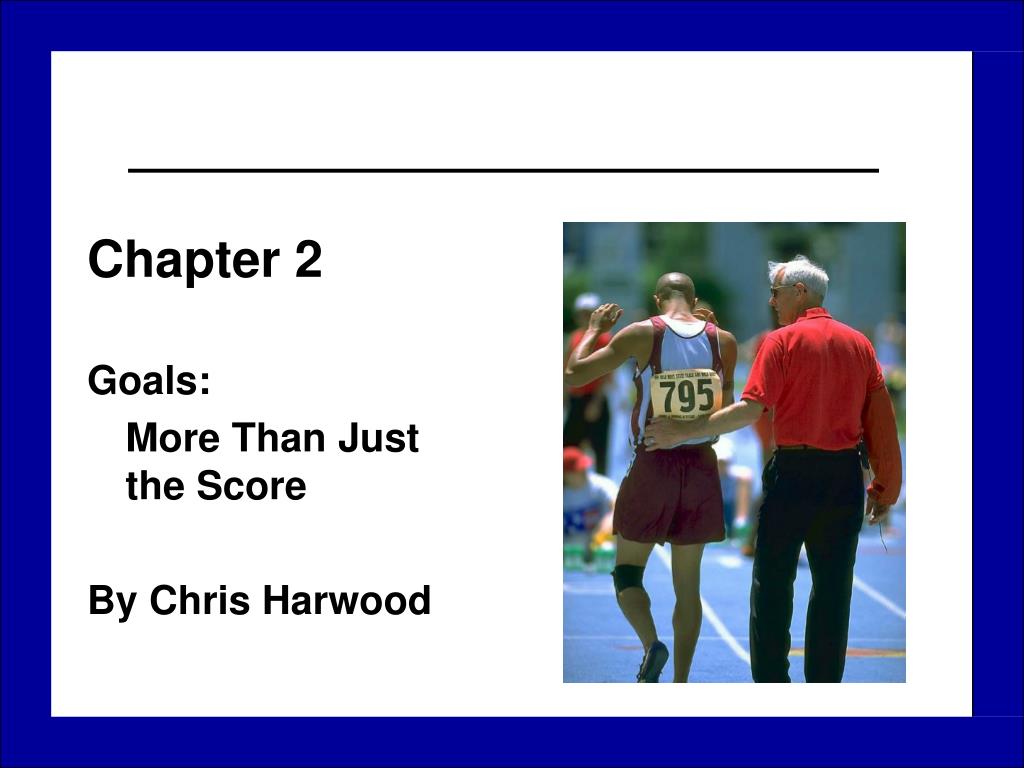
Chapter 2 Goals: More Than Just the Score By Chris Harwood

artan avatar
22 diapositives · 531 Views · Sep 23, 2014

Chapter 2 Goals: More Than Just the Score By Chris Harwood. Achievement Goal Theory. Developed by John Nicholls. Success and failure depend on an athlete’s perception of whether he or she has reached his or her personal goals.
Chapter 2 Goals: 	More Than Just the Score By Chris Harwood - slide 1
01 / 22Chapter 2 Goals: More Than Just the Score By Chris Harwood
1 / 17

Télécharger la présentation

Chapter 2 Goals: More Than Just the Score By Chris Harwood
Une image / un lien ci-dessous est fourni (tel quel) pour télécharger la présentation

Politique de téléchargement : le contenu du site vous est fourni TEL QUEL pour votre information et votre usage personnel ; il ne peut être vendu, concédé sous licence ni partagé sur d’autres sites sans l’accord de son auteur.Le contenu vous est fourni TEL QUEL, pour votre information et votre usage personnel uniquement. Téléchargez la présentation en cliquant sur ce lien. Lors du téléchargement, si vous ne parvenez pas à télécharger une présentation, l’éditeur a peut-être supprimé le fichier de son serveur.Pendant le téléchargement, si vous ne parvenez pas à obtenir une présentation, le fichier a peut-être été supprimé par l’éditeur.

F I N

Plus de contenu associé

Transcription de la présentation
  1. Chapter 2 Goals: More Than Just the Score By Chris Harwood

  2. Achievement Goal Theory • Developed by John Nicholls. • Success and failure depend on an athlete’s perception of whether he or she has reached his or her personal goals. • Intensity and effort are driven by the type of goals one sets. • Achievement motivation depends on perceived ability. This is determined by self-referencing or normative referencing.

  3. Links Between Goals and Actions • All athletes have an innate preference for task- or ego-involved goals in sport. • These predispositions are referred to as goal orientations. • Degree of involvement lies along a continuum. A specific athlete can have high, medium, or low levels of both ego and task involvement.

  4. Goal Orientation • Task-involvement orientation • Self-referenced criteria are important. • Involves mastery of a skill. • Athlete wants to see improvement. • Feels self-confident when she has exerted effort and sees improvement. • Ego-involvement orientation • Social (normative) comparisons are important. • Athlete wants to demonstrate that she can outperform others. • Feels self-confident when others see her as a winner, when effort is not necessary.

  5. Development of Goal Orientation • Goal orientations develop throughout childhood. • They are influenced by significant people in athletes’ lives and by the sport situations they are exposed to. (continued)

  6. Development of Goal Orientation (cont) • Goal orientations are relatively stable and enduring characteristics that are largely formed by mid- to late adolescence. (continued)

  7. Development of Goal Orientation (cont) • Influenced by various factors: • Parents • Coaches • Peers • Role models • Sport situations • These factors combine to produce a powerful effect on the athlete’s perception of achievement, known as the motivational climate.

  8. Motivational Climate • One of the first researchers in this area was Carole Ames. • Even the comments made to athletes can send clear messages about expectations. Compare the following comments: • “He’s not as highly ranked as you. You should have no problem beating him.” • “Work hard for every point, and remember to keep your feet moving to the ball.”

  9. Task-Involving Motivational Climate • Mastery • Athlete receives positive reinforcement for • working hard, • demonstrating improvement, • helping others learn, and • believing that each player’s contribution is important.

  10. Ego-Involving Motivational Climate • Competitive • Athlete receives positive reinforcement for performing well and competing aggressively with other players. • Athletes are punished for mistakes. • Most attention is given to high-ability (star) athletes.

  11. Goal Orientation and Goals • The strength of goal orientation influences the choice of goals. • But the environment can exert a powerful effect on goals. • Even an athlete high in task orientation might choose ego goals if the competition is very public, if comparisons are often made, if feedback is critical, and if rewards or negative consequences for winning or losing are major.

  12. Perceived Ability • Athletes high in task orientation tend to have stable perceptions of ability. • Changes occur based on improvement and learning. • Athletes high in ego orientation alone have more fragile perceptions. • To protect themselves, high-ego athletes choose how much effort to invest; they tend to withdraw if failure is imminent.

  13. Tanking • Highly ego-involved athletes reduce effort to maximize ability when winning, and reduce effort to protect ability when losing. • When losing, such athletes are susceptible to tanking: • Reduction of effort • Excuse making (injury, illness) • Casual approach to performance

  14. New Directions in Research • Goal orientation and emotions • High ego involvement is associated with higher anxiety, disrupted concentration, and venting. • Goal orientation and information processing • Athletes with high task involvement seek feedback; balanced athletes use more mental skills (imagery and mental rehearsal). • Goal orientation and moral behavior • High ego tends to be related to unsportsmanlike conduct and lower moral behaviors.

  15. Measuring Goal Orientation • Task and Ego Orientation in Sport Questionnaire (TEOSQ) • 14-item self-report • 2 scales: task and ego (continued)

  16. Measuring Goal Orientation (cont) • Perceptions of Success Questionnaire (POSQ) • 12-item self-report inventory • Measures the following factors: • Task orientation • Ego orientation

  17. Statements That Indicate an Ego Orientation When do you feel most successful in your sport? • When I can do better than my friends • When I score the most points • When I’m the best • When I beat other people • When I accomplish something others can’t do

  18. Statements That Indicate a Task Orientation When do you feel most successful in your sport? • When I learn a new skill by trying hard • When I work really hard • When I do my very best • When I overcome difficulties • When I master something I couldn’t do before

  19. Competitive Performance Mentality (CPM) • A method developed by Harwood to help athletes resist the pressure to prove themselves to others • Provides the athlete with two tests: • Self-challenge: Strive to the best of your currentability (task) • Game challenge: Depends on the situation and skill level of opponents (ego) • Critical review after every competition is important

  20. Advanced Strategies for Coaches Suggested techniques for enhancing motivation • Develop a script. • The “newspaper article” exercise • Create a supportive climate. • Conveying a task-involving message to young athletes • Using the “language logbook” • Seek input. • The sport-involvement contract: a signed commitment to acceptable behaviors and recognized expectations

  21. Turning Dreams into Goals • “Goals are dreams with deadlines.” –Diana Scharf Hunt • Describe vision • Picture • Key elements • Best experiences • Core values • Motivatiors • Gap • Confidence • Challenges • Strengths • Supports • Strategies • Summarize & Confirm • Ready, Confident, & Committed

  22. SMART Goals • S • M • A • R • T • Attendance • 83% (self goal) vs. 67% (instructor goal) • Adherance • 47% (SG) vs. 28% (IG) 3 months later