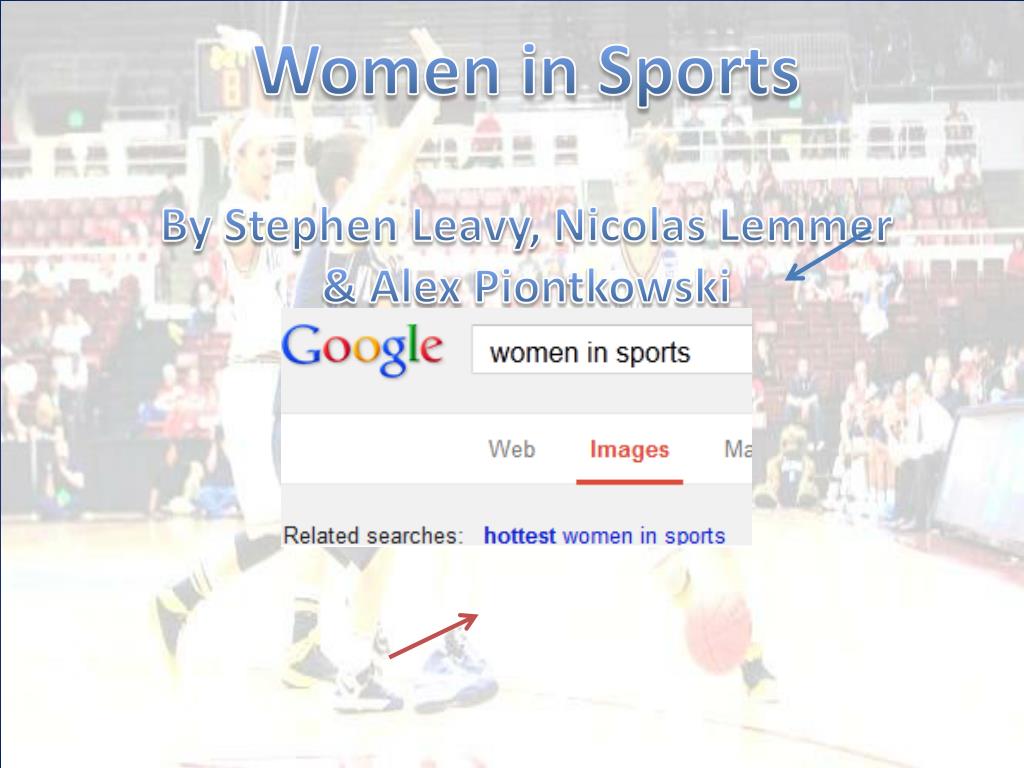
Women in Sports By Stephen Leavy, Nicolas Lemmer & Alex Piontkowski
What are Women’s Sports?
What are Women’s Sports?
A Sad Reality… • Discouraged from playing sport by being called lesbians • Can’t play sports and be feminine • Have to play second to the men’s teams in terms of resources and support • Their race effects their opportunities to participate in sports
Gender Roles in Sports • MALE • Game plan around star players • Naturally Aggressive • Harsher coaching style • Capable of higher level of athletics • Handle more strenuous activities • More physical • More competitive • FEMALE • Team first strategy, high involvement • Coached to build self esteem • Coached as to not be inconsiderate • Pushed towards aesthetically pleasing sports • Gymnastics • Figure Skating • Synchronized Swimming • GENDER ROLE VIOLATIONS • Lead to false accusations of players sexuality • Females seen as unattractive • More masculine • Values and social roles questioned http://www.sbrforum.com/video/family-guy-wnba-best-quality-youtube-v-5081 SBR Forum (2)
Stereotypes of Women’s Sports • Lesbian/Butch • “The term butch tends to denote a degree of masculinity displayed by a female-assigned individual beyond what would be considered typical of a tomboy”* • In place of physically fit and strong • Masculine/Unattractive • Cannot both participate in sports and still maintain attractiveness by society’s standards • Masculine characteristics have a direct correlation to success • Traits seen as negative instead of hard earned achievements http://www.youtube.com/watch?v=SugIyPf4Ci8 *Definition obtained from Wikipedia (6)
Participation Disparities • Due to these negative effects gender roles and stereotypes have on women and simply a lack of access, sports participation rates among girls are significantly lower than boys’ rates. • The numbers are even more discouraging for high school sports, with girls receiving about 1.3 million less opportunities to play sports then boys. (4) Women Sports Foundation (4)
Was Title IX Enough? • Title IX was designed to eliminate discrimination in participation in college sports based on sex • However, participation and funding for women’s sports has still not caught up to men’s • Female athletes receive only 43% of available opportunities, even though they make up about 57% of the college population (5) • On average, collegiate women’s sports receive 45% of funding, while men’s sports receive 55% (5) • Average salaries for head coaches of women’s sports are about $930,000 less than men’s. (5) NCAA (5)
Lack of Opportunities Leads to Loss of Benefits • Benefits of participating in sports: • Promotes healthy behavior • Teaches life skills such as teamwork, leadership, discipline, etc. • Without the opportunities to play sports, many young women are missing out on these benefits • Studies show that girls involved in sports are • Less likely to have an unintended pregnancy. • Less likely to become involved with drugs • More likely to graduate than non-athletes
Women in Sports - Geography Girls in urban and rural communities have less participation opportunities Only 59 % of 3rd -5th grade girls who live in urban areas are involved in at least one organized sport, (80 % for boys) Women Sports Foundation (4)
Women in Sports – Race & Ethnicity • Larger gender gap in participation exists in minorities as opposed to Caucasians • Caused by reinforcing stereotypes and lack of opportunities Women Sports Foundation (4)
Women in Sports - Class • People who need the benefits sports have to offer the most are the underprivileged • Girls from low-income families have the lowest sports participation at younger ages Women Sports Foundation (4)
Women in Sports – Race and Class Women Sports Foundation (4)
Narrow Window of Opportunity • More participation inequity for girls: • Urban and Rural Areas • Minority race • Low-income families
Plan of Action • Raise awareness of the gender inequity that still exists in sports • Emphasis on how and why certain groups are subject to more inequity than others http://womensportsequality.wordpress.com/
Works Cited 1. “Butch and Femme.” 2 Apr. 2013. <http://en.wikipedia.org/wiki/Butch_and_Femme>. (Used for definition of butch) 2. “Family Guy WNBA Best Quality Links on Youtube.” Family Guy Best Quality Links on Youtube. 2 Apr. 2013. <http://www.sbrforum.com/video/family-guy-wnba-best-quality-youtube-v-5081/>. 3. From the "Muscle Moll" to the "Butch" Ballplayer: Mannishness, Lesbianism, and Homophobia in U.S. Women's Sport. Susan K. Cahn. Feminist Studies , Vol. 19, No. 2, Women's Bodies and the State (Summer, 1993), pp. 343-368 4. “Go Out and Play.” WomenSportsFoundation.org. Oct. 2008. Women in Sports Foundation. <http://www.womenssportsfoundation.org/en/home/research/articles-and-reports/mental-and-physical-health/~/media/PDFs/WSF%20Research%20Reports/Go%20Out%20and%20Play_FULL%20REPORT.ashx:>. 5. Latest News. National Collegiate Athletic Association, Nov. 2011. Web. 2 Apr. 2013. <http://www.ncaa.org/wps/wcm/connect/public/NCAA/Resources/Latest News/2011/November/College sports participation rates continue upward trend>. 6. Symons, Caroline. Come out to Play: The Sports Experiences of Lesbian, Gay, Bisexual and Transgender LGBT) People in Victoria. [Melbourne, Vic.]: Institute of Sport, Exercise and Active Living, 2010. Print. Wilde, Kristen. Women in Sport: Gender Stereotypes in the Past and Present.