Download
1 / 1
10 likes | 138 Vues
This paper introduces the Adaptive Dual AK-D Tree Search Algorithm (ADAK-D Tree) designed to enhance the accuracy of the Iterative Closest Point (ICP) algorithm in registration applications. ADAK-D Tree employs a dual K-D tree search method with adaptive thresholds to identify significant coupling points effectively. By utilizing two projection orders, it retains true nearest neighbor points for improved registration precision. Experimental results demonstrate that ADAK-D Tree outperforms the traditional AK-D Tree regarding registration accuracy on facial surface data, yielding a mean squared error reduction.

E N D
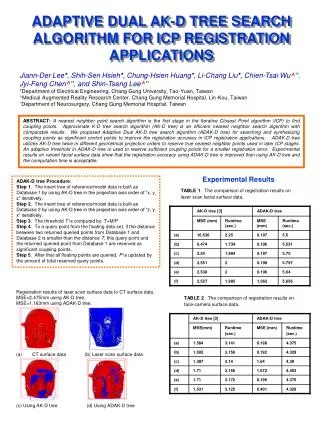
ADAPTIVE DUAL AK-D TREE SEARCH ALGORITHM FOR ICP REGISTRATION APPLICATIONS Jiann-Der Lee*, Shih-Sen Hsieh*, Chung-Hsien Huang*, Li-Chang Liu*, Chien-Tsai Wu^”, Jyi-Feng Chen^”, and Shin-Tseng Lee^” *Department of Electrical Engineering, Chang Gung University, Tao-Yuan, Taiwan ^Medical Augmented Reality Research Center, Chang Gung Memorial Hospital, Lin-Kou, Taiwan “Department of Neurosurgery, Chang Gung Memorial Hospital, Taiwan ABSTRACT: A nearest neighbor point search algorithm is the first stage in the Iterative Closest Point algorithm (ICP) to find coupling points. Approximate K-D tree search algorithm (AK-D tree) is an efficient nearest neighbor search algorithm with comparable results. We proposed Adaptive Dual AK-D tree search algorithm (ADAK-D tree) for searching and synthesizing coupling points as significant control points to improve the registration accuracy in ICP registration applications. ADAK-D tree utilizes AK-D tree twice in different geometrical projection orders to reserve true nearest neighbor points used in later ICP stages. An adaptive threshold in ADAK-D tree is used to reserve sufficient coupling points for a smaller registration error. Experimental results on variant facial surface data show that the registration accuracy using ADAK-D tree is improved than using AK-D tree and the computation time is acceptable. Experimental Results ADAK-D tree Procedure: Step 1. The insert tree of reference/model data is built as Database 1 by using AK-D tree in the projection axis order of “x, y, z” iteratively. Step 2. The insert tree of reference/model data is built as Database 2 by using AK-D tree in the projection axis order of “z, y, x” iteratively. Step 3. The threshold T is computed by: T=M/P Step 4. To a query point from the floating data set, if the distance between two returned queried points from Database 1 and Database 2 is smaller than the distance T, this query point and the returned queried point from Database 1 are reserved as significant coupling points. Step 5. After that all floating points are queried, P is updated by the amount of total reserved query points. TABLE 1. The comparison of registration results on laser scan facial surface data. • Registration results of laser scan surface data to CT surface data. • MSE=2.475mm using AK-D tree. • MSE=1.163mm using ADAK-D tree. • CT surface data (b) Laser scan surface data • (c) Using AK-D tree (d) Using ADAK-D tree TABLE 2. The comparison of registration results on face-camera surface data.