Solar Instruments on PROBA2: Innovations in Solar Observation
10 likes | 133 Vues
Launched on November 2, 2009, the PROBA2 satellite, developed by Verhaert Space NV, carries advanced solar instruments SWAP and LYRA, led by the Royal Observatory of Belgium. These instruments exemplify international collaboration, with LYRA monitoring solar irradiance in multiple UV passbands critical for aeronomy and space weather. SWAP provides UV imaging of the solar corona, utilizing state-of-the-art detector technology and multilayer mirrors. Together, they mark significant advancements in solar research and instrument calibration, paving the way for future missions.


Solar Instruments on PROBA2: Innovations in Solar Observation
E N D
Presentation Transcript
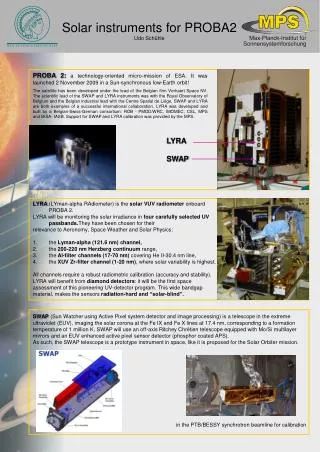
Solar instruments for PROBA2 Udo Schühle PROBA 2: a technology-oriented micro-mission of ESA. It was launched 2 November 2009 in a Sun-synchronous low-Earth orbit! The satellite has been developed under the lead of the Belgian firm Verhaert Space NV. The scientific lead of the SWAP and LYRA instruments was with the Royal Observatory of Belgium and the Belgian industrial lead with the Centre Spatial de Liège. SWAP and LYRA are both examples of a successful international collaboration. LYRA was developed and built by a Belgian-Swiss-German consortium: ROB - PMOD/WRC, IMOMEC, CSL, MPS and BISA- IASB. Support for SWAP and LYRA calibration was provided by the MPS. LYRA SWAP LYRA (LYman-alpha RAdiometer) is the solar VUV radiometer onboard PROBA 2. LYRA will be monitoring the solar irradiance in four carefully selected UV passbands.They have been chosen for their relevance to Aeronomy, Space Weather and Solar Physics: • the Lyman-alpha (121.6 nm) channel, • the 200-220 nmHerzberg continuumrange, • the Al-filter channels (17-70 nm) covering He II-30.4 nm line, • the XUV Zr-filter channel (1-20 nm), where solar variability is highest. All channels require a robust radiometric calibration (accuracy and stability). LYRA will benefit from diamond detectors: it will be the first space assessment of this pioneering UV-detector program. This wide bandgap material, makes the sensors radiation-hard and “solar-blind”. SWAP (Sun Watcher using Active Pixel system detector and image processing) is a telescope in the extreme ultraviolet (EUV), imaging the solar corona at the Fe IX and Fe X lines at 17.4 nm, corresponding to a formation temperature of 1 million K. SWAP will use an off-axis Ritchey Chrétien telescope equipped with Mo/Si multilayer mirrors and an EUV enhanced active pixel sensor detector (phosphor coated APS). As such, the SWAP telescope is a prototype instrument in space, like it is proposed for the Solar Orbiter mission. in the PTB/BESSY synchrotron beamline for calibration