Probing Hydrogen Atom Motion in Mn[N(CN)2]2-Pyrazine System using DCS Experiment
90 likes | 189 Vues
Study rotational dynamics of ligands in Mn[N(CN)2]2-pyrazine system via Disc Chopper Spectrometer at 408K and 435K phases. Explore hydrogen atoms' motion behavior with TOF instrument, deuterated and protonated samples, and data analysis techniques.


Probing Hydrogen Atom Motion in Mn[N(CN)2]2-Pyrazine System using DCS Experiment
E N D
Presentation Transcript
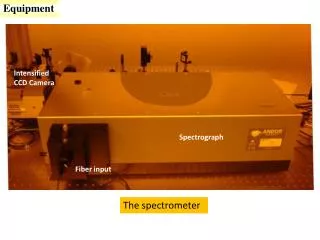
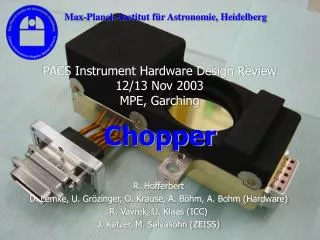
Experiment using the Disc Chopper Spectrometer Rotational Ligand Dynamics Group D S. Diallo, I-K. Jeong, S. Jonas, D. Phelan, Y. Liu, V. Atakan, H. Wu
Our system: Mn[N(CN)2]2.pyrazine • . At 408 K • - Large Debye-Waller Factor on pyrazine • -Phase transition • At 435 K Decomposes and loses pyrazine
Experiment • The goal is to probe the motion of the Hydrogen atoms in Mn[N(CN)2]2.pyrazine.
Measurement and Data Analysis • Deuterated sample for coherent Bragg diffraction to obtain structure as a function of temperature and paramagnetic structure • Protonated to observe both single particle motion (quasielastic) and to weigh the inelastic scattering spectrum in favor of hydrogen (vibrations)
EISF!! QISF!! Protonated Data fitting using DAVE Ao = ½[1+sin(2Qr)/(2Qr)] At T= 425 K
Elastic Incoherent Scattering Function (EISF) T=425K, Fitting of EISF, Eq: p0 + p1 * sin(p2*x)/(p2*x) R=p2=3.86(3)A
Conclusions and further considerations • In our fitting, we did find a good value of the rotation radius using the two-fold model.