Comprehensive Summary of Information Systems Strategy and Development Methods Course by John Krogstie
This course summary outlines the key components of Information Systems (IS) strategy and development methods. It covers three major interrelated areas: the importance of IS strategy, available technology, and IS development methods. Key topics include competitive forces, the role of knowledge management, ERP systems, and new organizational structures influenced by IT. Students should be able to connect theory with practical cases, evaluate IS applications, and apply various modeling languages. This foundation is crucial for future roles in IS consulting and further studies.

Comprehensive Summary of Information Systems Strategy and Development Methods Course by John Krogstie
E N D
Presentation Transcript
Today: Course Summary John Krogstie, IDI
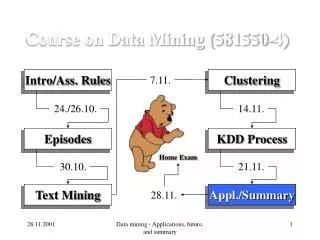
Summary of the entire course • Three major, interrelated parts: P & S book Last part last exercise H book IS strategy H book UML Dist Exercises Lecture notes IS Dev methods H book (ch 1-3) Notes about ERP Lecture notes Exercise 1 P&S book Available technology
IS Strategy – what should have been learnt? • The importance of IS stategy • Challenges of modern organizations • Competition, increased effeciency • Organizations must HAVE a strategy, and • Ensure that IS projects are in line with the strategy • Understanding basic strategy frameworks • The IS strategy triangle • Eras of information usage • 5 competitive forces, value chain (Porter)
IS Strategy (cont.) • How IT and the use of information has evolved • And how it is affecting the organization, e.g. • Flatter org. structures, network org., T-form org. • New org.types, e.g., virtual corporations, strategic alliances, co-opetition • Effect on management • How IT changes the nature of work • New types of jobs, new patterns of collaboration • Evaluation, compensation, rewarding, hiring • Telecommuting: advantages and disadvantages • Gaining acceptance for IT-induced change
IS Strategy, cont. • IT and changing business processes • Silo vs process perspective • TQM vs BPR • Enterprise systems and application packages vs process change • Funding of IT • Funding of IT Department • Valuing of IT Investments • Monitoring of IT Performance • Knowledge management • Why manage knowledge? • Knowledge as competitive advantage • And forces driving this development • Knowledge taxonomies • Knowledge management processes • Types of KM projects (and difference from IT projects)
IS Strategy and the exam • Should be able to • Explain basic concepts and frameworks • Write discussion essays • Similar to discussion questions after each chapter • Based on (shorter) case descriptions • Ability to relate concrete case to textbook concepts, trends, principles, frameworks • Write critical assessments of suggested answers to such questions
Available technology – what should be learnt? • Understanding different types of information systems and applications often found • Traditional IS applications • Types and purpose • Problems / challenges with these • Novel types of applications / packages • ERP, EAI, corporate portals • Data warehouses • Workflow, collaboration support software • B2B and B2C integration • More detailed insight: only ERP • E.g., functionality, architecture, configuration
Available technology and the exam • Should be able to • Explain / distinguish between different types of applications • Given a problem (case description), discuss what type(s) of application might fit • For ERP, • Explain the purpose of ERP • Explain the basic functionality and architecture of package solutions (e.g., SAP R/3) • Explain how development method and requirements analysis will be different for ERP vs traditional custom-development projects • Discuss pros and cons of ERP, typical pitfalls and issues to consider when buying or adapting • Given a case description, discuss whether ERP is a good solution or not
IS development methods – what should be learnt? • Modelling: • Languages: • Data Flow Diagrams • + connection to ER diagrams • Process descriptions (e.g., decision tables) • UML activity diagrams • Understand • Concepts and notation • When to use the languages, how to use them • Ability to make models • Ability to review models • Various review techniques • Syntactic, semantic, and pragmatic quality
IS dev., cont. • Requirements elicitation & specification • Various elicitation techniques • Interview, workshop: how to do them • Others: what they are • Which are good in which situations? • Different levels of requirements: • Goal level, domain level, product level, design level • Task & Support tables vs use cases • Which levels are appropriate for what project types? • Non-functional requirements • Importance and challenges of NF reqs • Taxonomies (different types of NF reqs) • Security requirements • Interoperability requirements
IS development and the exam, possible Q’s • Make models / requirements • From natural language case description • Translate from one representation to another • Evaluate a model or some textual requirements • Wrt syntactic / semantic / pragmatic quality • And guidelines for the particular format • Given a NL case description • Suggest use of reqs elicitation techniques • Given a project context • Or evaluate a given suggestion • Or evaluate an interview / workshop performance given transcript of a dialogue
What can this knowledge be used for? • Future work • The course covers basics for IS consultants • But need to learn more • On the job, or from future courses • Future courses • More about IS development methodology • TDT4250 Modelling of IS • TDT4290 Customer-driven project • TDT4235 Software quality and process improvement • More about available technology • TDT4245 Collaboration technology • TDT4215 Document management and text mining • TDT4210 Healthcare informatics • More about strategy • Ind-econ. courses?
The exam itself • 4 hours written, Friday 2 June • No multiple choice questions • Allowed to bring • Simple calculator (but no real need) • The Hawryszkiewycz book • Not allowed to bring • Any other books or papers • Precise reading list can be found on the course web page • Do you want a ”questions” meeting? (and when?)