Download
1 / 30
300 likes | 445 Vues
This lecture introduces Maxwell's Equations, foundational principles of electromagnetism published by J.C. Maxwell in 1861. It discusses the relationship between electric fields (E) and magnetic fields (B), and how these fields propagate as electromagnetic waves in linear, isotropic, homogeneous media. Key laws such as Gauss's, Faraday's, and Ampere's are covered, along with the implications of electromagnetic waves being transverse. The lecture also explores the wave equation, wave properties, and the electromagnetic spectrum, emphasizing the role of light as electromagnetic radiation.

E N D
Light is electromagnetic radiation! • = Electric Field • = Magnetic Field • Assume linear, isotropic, homogeneous media. PHY 530 -- Lecture 01
Maxwell’s Equations • Published by J.C. Maxwell in 1861 in the paper “On Physical Lines of Force”. • Unite classical electricity and magnetism. • Predict the propagation of electromagnetic energy away from time varying sources (current and charge) in the form of waves. PHY 530 -- Lecture 01
Maxwell’s Equations • Four partial differential equations involving E, B that govern ALL electromagnetic phenomena. • Gauss’s Law (elec, mag) • Faraday’s Law, Ampere’s Law PHY 530 -- Lecture 01
Gauss’s Law (elec) Charge density Electric permittivity constant of medium E dS= q Total charge enclosed dS– outward normal Electric charges give rise to electric fields. PHY 530 -- Lecture 01
Gauss’s Law (mag) B dS = 0 No Magnetic Monopoles! PHY 530 -- Lecture 01
Faraday’s Law where: = mag. flux A changing B field gives rise to an Efield E field lines close on themselves (form loops) PHY 530 -- Lecture 01
Ampere’s Law Where: Magnetic permeability of medium If Econst in time: Electric current j = current density Electric currents give rise to B fields. PHY 530 -- Lecture 01
What Maxwell’s Equations Imply In the absence of sources, all components of E, B satisfy the same (homogeneous) equation: The properties of an e.m. wave (direction of propagation, velocity of propagation, wavelength, frequency) can be determined by examining the solutions to the wave equation. PHY 530 -- Lecture 01
What does it mean to satisfy the wave equation? Imagine a disturbance traveling along the x coordinate (1-dim case). PHY 530 -- Lecture 01
What does a wave look like mathematically? General expression for waves traveling in +ve, -ve directions: Argument affects the translation of wave shape. is the velocity of propagation. PHY 530 -- Lecture 01
Waves satisfy the wave equation • Try it for f! Use the chain rule, differentiate: • This is the (homogeneous) 1-dim wave equation. PHY 530 -- Lecture 01
E, B satisfy the 3-dim wave equation!! can be and PHY 530 -- Lecture 01
Index of Refraction (1) Okay, Velocity of light in a medium dependent on medium’s electric, magnetic properties. In free space: PHY 530 -- Lecture 01
Index of Refraction (2) For any l.i.h. medium, define index of refraction as: NOTE: dimensionless. PHY 530 -- Lecture 01
Index of Refraction (3) PHY 530 -- Lecture 01
Plane waves Back to the 3-dim wave equation, but assume has constant value on planes: PHY 530 -- Lecture 01
Seek solution to wave eqn Solving PDEs is hard, so assume solution of the form: (so-called “separable” solution…) Now, Becomes: PHY 530 -- Lecture 01
Voilà! Two ordinary differential equations! Note! and PHY 530 -- Lecture 01
We know the solutions to these... where . (Sines and cosines!) PHY 530 -- Lecture 01
How to build a wave Choose w positive, +ve z dir, then have Any linear combination of solutions of this form is also a solution. Start with sines and cosines, make whatever shape like. PHY 530 -- Lecture 01
Let’s get physical Sufficient to study Harmonic wave kz-ωt - phase (radians) ω - angular frequency k – propagation number/vector wavelength frequency PHY 530 -- Lecture 01
3-D wave equation Solution: Reduces to the 1-D case when PHY 530 -- Lecture 01
Back to Plane Waves Assume we have (plane waves in the z-direction, E0 a constant vector) , Similar equations for B. PHY 530 -- Lecture 01
Electromagnetic Waves are Transverse Differentiate first equation of previous slide, can show then using Maxwell’s equations that: Try it! PHY 530 -- Lecture 01
EM Waves are Transverse (2) This implies: Fields must be perpendicular to the propagation direction! PHY 530 -- Lecture 01
EM Waves are Transverse (3) Also, fields are in phase in the absence of sources and E is perpendicular to B since E k B PHY 530 -- Lecture 01
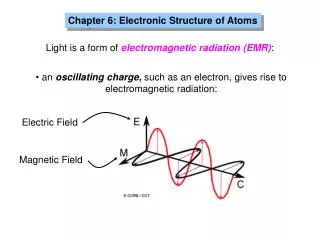
What light looks like close up Moving charge(s) Electric Field Waves + The Electric and Magnetic components of light are perpendicular (in vacuum). Waves propagate with speed 3x10⁸ m/s. Magnetic Field Waves PHY 530 -- Lecture 01
The Poynting Vector S is parallel to the propagation direction. In free space, S gives us the energy transport of waveform. Energy/time/area I = <|S|>time=1/2(c ε0) E02 - irradiance (time average of the magnitude of the Poynting vector) PHY 530 -- Lecture 01
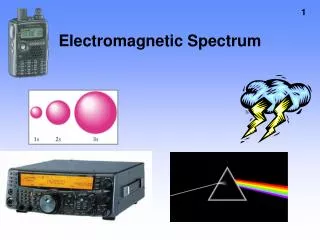
The Electromagnetic Spectrum PHY 530 -- Lecture 01
The Electromagnetic Spectrum PHY 530 -- Lecture 01