Solid Dispersion Development to Enhance Solubility & Oral Bioavailability | Auri
0 likes | 0 Vues
Discover how Aurigene Services tackled poor solubility and low oral bioavailability in a challenging small-molecule API through advanced formulation science. This detailed case study highlights the development of a solid dispersion and nanosuspension strategy to improve drug solubility, achieve dose-dependent systemic exposure, and support chronic rodent toxicology studies with a safe, scalable oral formulation.<br><br>https://www.aurigeneservices.com/case-studies/solid-dispersion-development-enhance-solubility-and-oral-bioavailability-rodent-toxicology-studies


Solid Dispersion Development to Enhance Solubility & Oral Bioavailability | Auri
E N D
Presentation Transcript
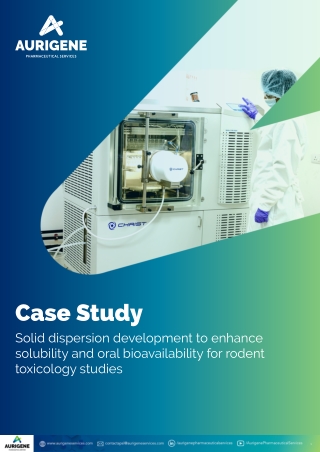
Case Study Solid dispersion development to enhance solubility and oral bioavailability for rodent toxicology studies 1
Background: • Develop oral liquid dosage form of an IND candidate (small molecule) suitable for chronic toxicology studies in rats. • Must meet required systemic exposure and shall be dose proportional. • Developed vehicle or used excipients shall be safe for chronic preclinical toxicology studies. Challenges: • Low oral bioavailability • Practically insoluble in bio relevant media • Basic in nature with precipitation potential at intestinal pH • Salt did not improved solubility • Poorly soluble in lipid excipients so limited scope for LBDDS Aurigene solution: • Assessment of biopharmaceutical properties indicated solubility limited oral absorption. Hence, two approaches solid dispersion and nanosuspension were evaluated to enhance oral bioavailability. • API was crystalline and showed significant increase in solubility on ionization. These two physicochemical properties were used for solid dispersion formulation development. • Solid dispersion and reconstitution vehicle was developed to result in enhance soluble content with minimum precipitation at intestinal pH. • Nanosuspension was prepared by ‘top down technology’ using bead mill. Outcome: • Dose depended target systemic exposures were obtained by enhancing solubility through in situ salt and amorphization using solid dispersion approach Highlights: • Target systemic exposure was achieved with developed solid dispersion based solution formulation • Dose dependent increase was observed • Due to increase in oral bioavailability, required highest toxicology dose got lowered which hugely reduced API requirement for 90 days GLP toxicology studies. 2
Figure-1: Soluble content in liquid formulation for dosing in various formulation approaches and compositions Figure-2: Systemic exposure from various formulation approaches in rodent species 3
Thank You For more information please visit https:/ /www.aurigeneservices.com/ To place an inquiry please visit https:/ /www.aurigeneservices.com/form/contact Mail us at contactapsl@aurigeneservices.com 4