Download
1 / 1
10 likes | 124 Vues
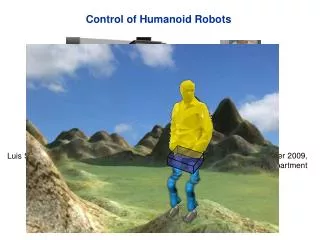
This paper explores a novel approach to robot behavior composition through a "live object" hierarchy. Live objects integrate data, algorithms, and control within a multi-threaded architecture, enabling automated mode-switching for formation control of multiple autonomous robots. Utilizing reinforcement learning facilitates effective mode-switching, minimizing software development time. The design supports seamless integration of sensing and control algorithms, ensuring predictable performance in robotic formations. The concepts are demonstrated with Sony Aibo robots in various formations, showcasing rapid deployment and automated tasking.

E N D
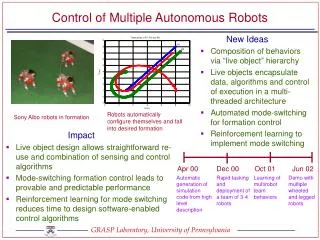
New Ideas Composition of behaviors via “live object” hierarchy Live objects encapsulate data, algorithms and control of execution in a multi-threaded architecture Automated mode-switching for formation control Reinforcement learning to implement mode switching Impact Live object design allows straightforward re-use and combination of sensing and control algorithms Mode-switching formation control leads to provable and predictable performance Reinforcement learning for mode switching reduces time to design software-enabled control algorithms 9 8 7 6 5 4 3 2 1 0 -1 -2 0 2 4 6 8 10 Control of Multiple Autonomous Robots Trajectories of R1, R2 and R3 R1 R2 R3 Y (m) X (m) Robots automatically configure themselves and fall into desired formation Sony Aibo robots in formation Apr 00 Dec 00 Oct 01 Jun 02 Automatic generation of simulation code from high level description Rapid tasking and deployment of a team of 3-4 robots Learning of multirobot team behaviors Demo with multiple wheeled and legged robots