High-Accuracy, Quick-Change, Robot Factory Interface
This project focuses on the design, testing, and demonstration of a modular robot baseplate that utilizes kinematic couplings for precision interfacing. It aims to create a repeatable, quickly exchangeable connection between the robot foot and floor plate, facilitating easy calibration and installation at customer sites. Adaptive coupling designs and experimental tests showcase significant reductions in positioning error, enhancing robotic operation efficiency. The integration of interfacing calibration with ABB software allows for deterministic control over tool center point (TCP) accuracy, streamlining manufacturing processes.

High-Accuracy, Quick-Change, Robot Factory Interface
E N D
Presentation Transcript
High-Accuracy, Quick-Change, Robot Factory Interface John Hart (ajhart@mit.edu)Prof. Alexander Slocum, AdvisorMIT Precision Engineering Research Group
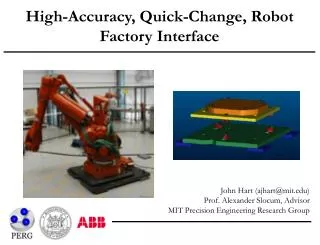
Project Goals Design, test, and demonstrate production feasibility of a modular robot baseplate with kinematic couplings as locators: • A repeatable, rapidly exchangeable interface between the foot (three balls/contactors) and floor plate (three grooves/targets) • Calibrate robots at ABB to a master baseplate • Install production baseplates at the customer site and calibrated the kinematic couplings directly to in-cell tooling • Install robot according to refined mounting process with gradual, patterned preload to mounting bolts • TCP-to-tooling relationship is a deterministic frame transformation • Base calibration data handling is merged with ABB software, enabling 0.1 mm TCP error contribution from repeatability and exchangeability error of kinematic couplings
Prototype Coupling Designs Design 3-point kinematic coupling mounts for the 6400R foot: Canoe Ball • Six “point” contacts • 0.5m radius ball surface • 20 mm diameter elastic Hertzian contact Three-Pin • Three line + three surface contacts • In-plane preload overcomes friction to deterministically seat pins • Vertical bolt preload engages horizontal contact surfaces
Prototype Coupling Designs Groove/Cylinder • Twelve line contacts • Aluminum cylinders • Apply bolt preload (elastic deflection of cylinders) for dynamic stability
Prototype Base Mounting Tests at ABB Robotics Vasteras, July/August 2001: • Static (bolted) and dynamic (5-point path) repeatability of canoe ball and three-pin interfaces • Static (manipulator rest only) repeatability of groove/cylinder interface • Test both basic (air wrench) and refined (torque wrench, greased bolts) mounting processes • Measure tool point motion using Leica LTD500 Laser Tracker • Repeatability of robot path + measurement system approximately 20 microns
Repeatability Performance • Canoe balls vs. BMW base = 83% reduction • Three-pin vs. BMW base = 85% reduction • Cylinders vs. BMW base = 92% reduction • Refined mounting vs. basic mounting = 50-70% reduction • 8-bolt blue pallet repeatability (not shown) = 1.63 mm
Interchangeability Error Model Consider stackup of errors in coupling manufacturing, mounting plate manufacturing, and coupling-to-plate assembly: For example in z-direction of a ball mount, tolerances: • Sphere radius = dRsph • Contact point to bottom plane = dhR • Measurement feature height = dhmeas • Protrusion height = dhprot Each dimension is perturbed by generating a random variate, e.g. for mounting hole placement:
Interchangeability Solution Method Linear system of 24 constraint equations between the balls and grooves – accounts for both positional and angular misalignment: Contact sphere centers must be at minimum (normal) distance between the groove flats, e.g.: By geometry, the combined error motion of contact spheres is known with respect to the error motion of their mounting plate. For small angles, e.g.: Solve linear system and place six error parameters in HTM: q1, b1 = initial, final center positions; N1 = groove normal; R1 = sphere radius. (qS,1, qS,1, qS,1) = initial center positions; (xS,1, yS,1, zS,1) = final center positions.
Interchangeability Results Simulate interchangeablity error from manufacturing variation: • Calibrate interfaces by measuring contacts and calculating interface error transformation • Model direct measurement of pins + contacts, and offset measurement of canoe balls • Exchangeability is error between calculated and true interface transformation, given chosen level of calibration and manufacturing tolerances (low, med, high) • 250-trial Monte Carlo simulation in MATLAB at each calibration level Three-pin interchangeability: 0 = no interface calibration 3 = full (x,y,z) of pins and contact surfaces
Total Mechanical Accuracy “Quick-Change” Accuracy = Repeatability + Exchangeability (measured) (simulated) Canoe balls Three-pin Groove/cylinder 0.22 mm = 0.06 + 0.16* 0.12 mm = 0.07 + 0.05 - = 0.06** + (Incomplete) • Interface calibration decouples accuracy from manufacturing tolerances of mounting plates and couplings (if direct measurement of contacts) • Results show repeatability is highly f(mounting process) – this may present a performance limit for factory mountings; interface should be micron-repeatable under perfect conditions • Totally, a near-deterministic prediction of robot interface accuracy *driven by error of offset position measurement **static only
Recommended Next Steps • Test groove/cylinder interface with preload + motion • Test traditional quasi-kinematic couplings • Evaluate long-term dynamic performance • Production three-pin adaptation to BMW base • Canoe ball 4-point mounting for Voyager? • Build kinematic coupling “Expert System” – combine test results, simulation results, etc. into design tool that gives minimum cost recommendation as f(accuracy requirement)