Understanding the Infratemporal Fossa: Mandibular Nerve and Its Clinical Significance
100 likes | 247 Vues
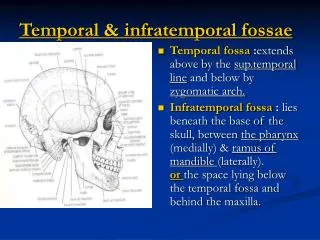
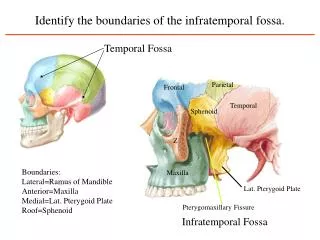
The infratemporal fossa is a complex anatomical space crucial in dental and maxillofacial procedures. It is bounded by the lateral pterygoid muscle laterally, the medial pterygoid muscle medially, and the maxilla anteriorly. Key structures within this fossa include the mandibular nerve's trunk and its divisions, the buccal nerve, and important ganglia like the otic and submandibular. Awareness of these anatomical features is essential for managing injuries, performing dental anesthesia, and understanding conditions affecting jaw function.


Understanding the Infratemporal Fossa: Mandibular Nerve and Its Clinical Significance
E N D
Presentation Transcript
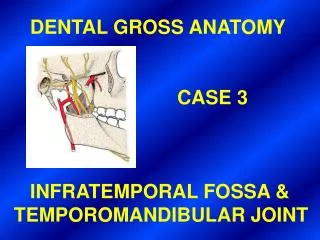
INFRATEMPORAL FOSSA MANDIBULAR NERVE
BOUNDARIES ROOF MEDIAL WALL ANTERIOR WALL LATERAL WALL
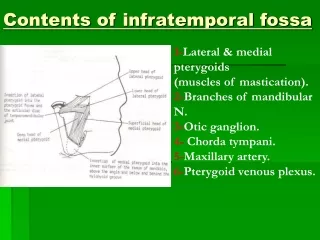
CONTENTS • Sphenomandibular ligament • Lateral pterygoid: upper & lower heads • Medial pterygoid: superficial & deep heads
MANDIBULAR NERVE trunk and anterior division Trigeminal ganglion Meningeal nerve To tensor tympani Deep temporal ns Nerve to lat pterygoid To tensor palati Buccal nerve u To masseter
Posterior division Auriculotemporal au Chorda tympani Lingual nerve Inferior alveolar To mylohyoid Incisive nerve Mental nerve
CHORDA TYMPANI Chorda tympani Lingual nerve Submandibular ganglion Sublingual gland Submandibular gland
APPLIED • Lingual nerve injury • Dental anaesthesia