Download
1 / 5
50 likes | 163 Vues
This guide provides essential information on scaffolding certification and safety standards in Queensland. It covers all critical sections including site hazards, tools and equipment necessary for scaffolding, general and specific scaffold requirements, and guidance on associated equipment. You will learn about the importance of isolating defective components, the proper installation of guardrails, and techniques for rope work. Whether you are a contractor or worker, this resource is designed to enhance your understanding of scaffold safety and compliance.

E N D
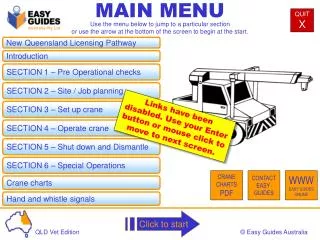
MAIN MENU QUIT X QLD Licensing Pathway Introduction SECTION 1 – Certification SECTION 2 – Site Hazards SECTION 3 – Tools and Equipment for Scaffolding Links have been disabled. Use your Enter button or mouse click to move to next screen. SECTION 4 – General Scaffold Requirements SECTION 5 – Particular Scaffold Requirements SECTION 6 – Associated Equipment Requirements Basic Scaffolding - Written Assignment CONTACT EASY GUIDES WWW EASY GUIDES ONLINE Rope Work – Whipping, Splicing, Bends and Hitches Click to start
Examples of Modular Scaffolding Components right angle coupler spindle on adjustablebase plate hop up platform bracket caster with wheel lock gin wheel standard transoms brace wedge baseplate ledgers / guardrail scaffold plank soleplate
Corrosive substances on scaffolding may lead to structural failure of the scaffold Note: Ladder access has been removed for clarity
Isolating / tagging defective scaffolding components Defective scaffolding components have to be isolated or tagged to prevent re-use.
Height above the working platform a guardrail is fixed You would fix a guardrail not less than 900 mm and not more than 1100 mm (or any height between these two) above the working platform. 1100 mm 900 mm