Download
1 / 5
50 likes | 160 Vues
This guide outlines the essential steps for operating Elevated Work Platforms (EWP) in Queensland, covering pre-operational checks, site planning, setup, and shutdown procedures. It emphasizes the importance of safety equipment, including helmets and harnesses, and discusses assessing ground conditions to ensure stability. Key components of the EWP, such as cylinders and boom functionalities, are explained. Operators are reminded of the critical nature of adhering to the Safe Working Load (SWL) regulations to prevent accidents.

E N D
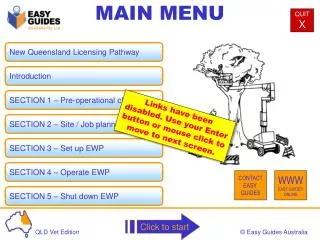
MAIN MENU QUIT X New Queensland Licensing Pathway Introduction SECTION 1 – Pre-operational checks Links have been disabled. Use your Enter button or mouse click to move to next screen. SECTION 2 – Site / Job planning SECTION 3 – Set up EWP SECTION 4 – Operate EWP CONTACT EASY GUIDES WWW EASY GUIDES ONLINE SECTION 5 – Shut down EWP Click to start
An example of an elevating work platform Slave Level Cylinder Main Boom Main Telescopic Cylinder Upright Main Lift Cylinder Upright Level Cylinder Tower Lift Cylinder Tower Boom Turntable Frame outrigger/stabiliser outrigger/stabiliser
Safety equipment that must be worn Two items of safety equipment that must be worn at all times while working in the platform of the EWP are: A safety helmet (hard hat) A safety harness with attached lanyard (with training on how it is to be worn correctly, stored and maintained). EWP basket
Soft or unstable ground If the stabilisers/outriggers are on soft or unstable ground you should: If at all possible relocate the EWP to stable ground. Suitable packing must be used to spread the load. WHAT DO YOU THINK? Assessment of ground conditions should be done by a competent person. levelling cylinder tilt switch Perform a stability test.
Exceeding the SWL The stated SWL / Rated Capacity must NEVER be exceeded.