

SlideServe
Menu
Préférences
© SlideServe · v2026

George Boole

awen avatar
13 diapositives · 715 Views · Jul 29, 2014

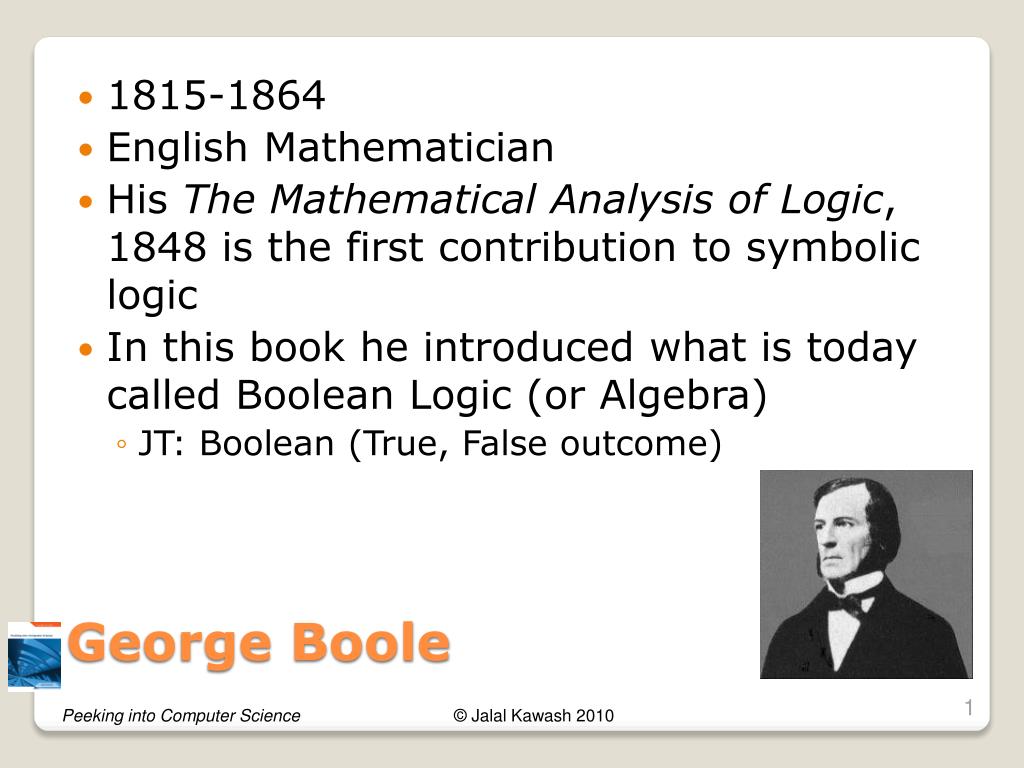
1815-1864 English Mathematician His The Mathematical Analysis of Logic , 1848 is the first contribution to symbolic logic In this book he introduced what is today called Boolean Logic (or Algebra) JT: Boolean (True, False outcome). George Boole. Logic. Peeking into Computer Science.
George Boole - slide 1
01 / 13George Boole
1 / 17

Télécharger la présentation

George Boole
Une image / un lien ci-dessous est fourni (tel quel) pour télécharger la présentation

Politique de téléchargement : le contenu du site vous est fourni TEL QUEL pour votre information et votre usage personnel ; il ne peut être vendu, concédé sous licence ni partagé sur d’autres sites sans l’accord de son auteur.Le contenu vous est fourni TEL QUEL, pour votre information et votre usage personnel uniquement. Téléchargez la présentation en cliquant sur ce lien. Lors du téléchargement, si vous ne parvenez pas à télécharger une présentation, l’éditeur a peut-être supprimé le fichier de son serveur.Pendant le téléchargement, si vous ne parvenez pas à obtenir une présentation, le fichier a peut-être été supprimé par l’éditeur.

F I N

Plus de contenu associé

Transcription de la présentation
  1. 1815-1864 • English Mathematician • His The Mathematical Analysis of Logic, 1848 is the first contribution to symbolic logic • In this book he introduced what is today called Boolean Logic (or Algebra) • JT: Boolean (True, False outcome) George Boole

  2. Logic Peeking into Computer Science

  3. Mandatory: Chapter 2 – Section 2.2 Reading Assignment

  4. Predicate Logic

  5. By the end of this section, you will be able to: • Define a predicate • Understand universal and existential quantifiers • Use quantification to convert a predicate to a proposition • Work with quantifier equivalence rules Objectives

  6. Proposition: a declarative sentence that is either true or false, but not both.1 • Example propositions • 3 > 4 • 4 > 3 JT: True/False clear cut 1) “Peeking into Computer Science” (2nd Ed) Kawash J. JT’s Extra: Review

  7. Predicate: a proposition where the value of a variable is unknown. • Example predicate • P(X): X > 0 JT: True/False “it depends” JT’s Extra: New Material

  8. X > 3 • Is not a proposition • X is taller than Y • Is not a proposition • These are predicates • P(X): X > 3 • Q(X,Y): X is taller than Y Predicate Logic

  9. Predicates can be made propositions by • Substituting values for the variables • P(X): X > 3, P(4) is true, P(-1) is false • Q(X,Y): X is taller than Y, Q(Debra, Doug) OR • Binding the variable with a quantifier • Universal Quantifier x P(x) • P(x) is true for all x in the universe of discourse • Existential Quantifier x P(x) • P(x) is true for at least one x in the universe of discourse Quantification

  10. Universe of discourse: this 203 class • P(x): x is female • x P(x) : • All students in this class are female • x P(x) • There is at least one student in this class who is female Quantification Examples

  11. Universe of discourse: all earth creatures • M(x): x is a monkey • F(x): x lives in a forest • Express: some monkeys live in forests • x (M(x)  F(x)) : • At least some monkey lives in a forest Quantification Examples

  12. Universe of discourse: all earth creatures • M(x): x is a monkey • F(x): x lives in a forest • Express: all monkeys live in forests • x (M(x)  F(x)) : • All earth creatures are monkeys and live in forests • x (M(x) → F(x)) : • From all creatures if x is a monkey, then x lives in a forest X Quantification Examples

  13. x P(x) is equivalent to  [x  P(x)] • All monkeys are black • There is no one monkey which is not black • x P(x) is equivalent to  [x  P(x)] • There is at least one student who likes the course • It is not the case that all students do not like the course Quantifier Equivalence