Chromosome Challenge
Participate in the Chromosome Challenge to test your understanding of cell division processes, including mitosis and meiosis. Answer a series of 20 questions covering key topics like prophase, chromosome numbers, spindle fibers, gamete formation, and more. Each participant will discuss and record their answers as a group within a 30-second time limit for each question. The team with the most correct answers will win a bonus! Delve into genetics, explore karyotypes, and understand the stages of division.

Chromosome Challenge
E N D
Presentation Transcript
Chromosome Challenge • Quietly discuss each question and then record your answer. You will be given about 30 seconds per question. The group with the most correct answers will win a bonus.
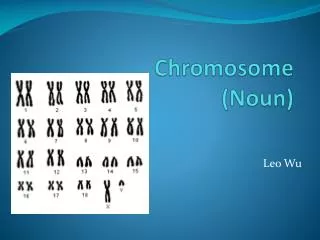
2 of 20) What is the haploid chromosome number of this karyotype?
3 of 20) In which picture are additional organelles being created?
4 of 20) Where do the spindle fibers attach to the chromosomes?
5 of 20) During which event do the 2 homologous chromosomes form a tetrad?
7 of 20) In which picture are additional copies of DNA being created?
9 of 20) Which stage of meiosis is shown in the picture below?
11 of 20) By letter, place the 5 pictures in order from start to finish.
12 of 20) Using this karyotype, how many chromosomes can be found in somatic cells?
13 of 20) Two part question.A) Where does spermatogenesis take place?B) Where does oogenesis take place?
15 of 20) Cytokinesis is often described as the splitting of the _____.
17 of 20) Match the stage of interphase with the descriptions. You can use the descriptions more than once. G1 Stage ????????????? S stage ????????????? G2 stage ????????????? Descriptions (A) Chromatin copied (B) Cells grow in size (C) Organelles created (D) Normal duty performed
A) Create gametes B) Creates somatic cells C) Creates diploid cells D) Creates haploid cells E) Creates egg cells F) Creates muscle cells G) Creates sperm cells H) Creates blood cells I) Creates cells that contain 1 of each chromosome J) Creates cells with chromosomes found in pairs 19 of 20) List all the meiosis characteristics.
20 of 20) Write the notation used to describe this person with Patau’s syndrome.
2 of 20) What is the haploid chromosome number of this karyotype? 24
3 of 20) In which picture are additional organelles being created?
4 of 20) Where do the spindle fibers attach to the chromosomes? centromere
5 of 20) During which event (of meiosis) does the 2 homologous chromosomes form a tetrad? synapsis
7 of 20) In which picture is additional copies of DNA being created?
8 of 20) Name this object. cell plate
9 of 20) Which stage of meiosis is shown in the picture below? Telophase 2
11 of 20) By letter, place the 5 pictures in order from start to finish.
12 of 20) Using this karyotype, how many chromosomes can be found in somatic cells? 48
13 of 20) Two part question.A) Where does spermatogenesis take place?B) Where does oogenesis take place? a) testes or testicles b) ovaries
15 of 20) Cytokinesis is often described as the splitting of the _____. cytoplasm
17 of 20) Match the stage of interphase with the descriptions. You can use the descriptions more than once. G1 Stage (B) Cells grow in size (C) Organelles created (D) Normal duty performed S stage (A) Chromatin copied G2 stage (B) Cells grow in size (D) Normal duty performed Descriptions A) Chromatin copied B) Cells grow in size C) Organelles created D) Normal duty performed
A) Create gametes B) Creates somatic cells C) Creates diploid cells D) Creates haploid cells E) Creates egg cells F) Creates muscle cells G) Creates sperm cells H) Creates blood cells I) Creates cells that contain 1 of each chromosome J) Creates cells with chromosomes found in pairs 19 of 20) List all the meiosis characteristics.
20 of 20) Write the notation used to describe this person with Patau’s syndrome. 47, XY, +13
Count up the incorrect answers and return the paper to the correct group.