Analysis of Stress Distribution in Fillet Regions Under Downward Pressure
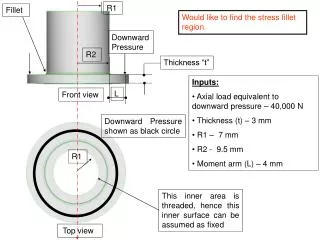
This study aims to identify the stress distribution in the fillet regions of a mechanical component subjected to a downward axial load of 40,000 N. The key input parameters include a thickness of 3 mm, radii R1 of 7 mm and R2 of 9.5 mm, and a moment arm of 4 mm. The inner area is threaded, allowing the assumption of a fixed inner surface. Using front and top views to visualize the applied load and geometrical parameters, we will determine areas of potential stress concentration and evaluate the structural integrity of the design.

Analysis of Stress Distribution in Fillet Regions Under Downward Pressure
E N D
Presentation Transcript
R1 Fillet Would like to find the stress fillet region. Downward Pressure R2 Thickness “t” • Inputs: • Axial load equivalent to downward pressure – 40,000 N • Thickness (t) – 3 mm • R1 – 7 mm • R2 - 9.5 mm • Moment arm (L) – 4 mm L Front view Downward Pressure shown as black circle R1 This inner area is threaded, hence this inner surface can be assumed as fixed Top view
R1 Fillet Would like to find the stress fillet region. Downward Pressure R2 Thickness “t” • Inputs: • Axial load equivalent to downward pressure – 40,000 N • Thickness (t) – 3 mm • R1 – 7 mm • R2 - 9.5 mm • Moment arm (L) – 4 mm L Front view Downward Pressure shown as black circle R1 This inner area is threaded, hence this inner surface can be assumed as fixed Top view