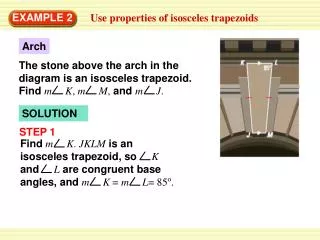
Understanding Parallelograms through Desk Lamp Mechanics
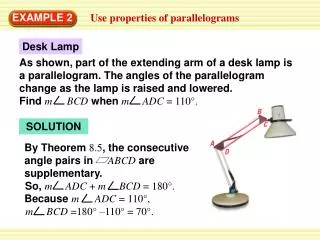
This guide covers the geometry of parallelograms by applying the principles through a desk lamp example. It illustrates how the angles of the parallelogram change when the lamp arm is adjusted. Using Theorem 8.5, it demonstrates how to find angle measures, specifically m.BCD when m.ADC is given as 110°. Additionally, the properties of parallelograms are explored using Theorem 8.6, highlighting that the diagonals bisect each other. Practical examples and solutions will enhance your understanding of these concepts.

Understanding Parallelograms through Desk Lamp Mechanics
E N D
Presentation Transcript
Desk Lamp As shown, part of the extending arm of a desk lamp is a parallelogram. The angles of the parallelogram change as the lamp is raised and lowered. Find m BCDwhen m ADC = 110°. By Theorem 8.5, the consecutive angle pairs in ABCD are supplementary. So, m ADC + m BCD = 180°. Because m ADC = 110°, m BCD =180° –110° = 70°. EXAMPLE 2 Use properties of parallelograms SOLUTION
By Theorem 8 .6, the diagonals of a parallelogram bisect each other. So, Pis the midpoint of diagonals LNand OM. Use the Midpoint Formula. 4 + 0 7 7 + 0 , , 2 Coordinates of midpoint Pof OM = ( ) ( ) = 2 2 2 ANSWER The correct answer is A. Standardized Test Practice EXAMPLE 3 SOLUTION
Find the indicated measure in JKLM. 6. 3. 4. 5. NM m KML KM m JML 4 70° 40° 2 ANSWER ANSWER ANSWER ANSWER for Examples 2 and 3 GUIDED PRACTICE