Download
1 / 6
60 likes | 187 Vues
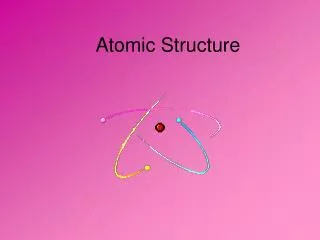
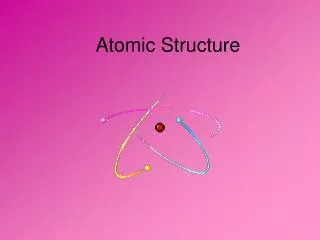
This review covers the fundamental aspects of atomic structure, focusing on subatomic particles: protons, neutrons, and electrons. Protons define elements through atomic numbers, while neutrons can vary in isotopes. Electrons influence the atom's charge and are involved in bonding and chemical behavior. The document explains how to count subatomic particles, represent atoms in various ways (e.g., K-39, 39K), and understand electron configurations, emphasizing valence electrons' role in chemical properties using Lewis Dot Diagrams.

E N D
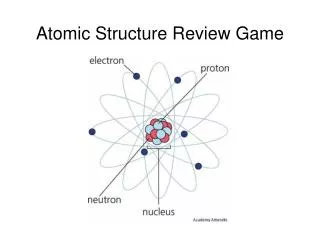
atoms • Protons: P+ identifies the element • Cannot change (atomic number) • Neutrons: No • Can change, called isotopes • Electrons: E- • Can change, called ions Counting Subatomic particles • Atoms can be written 3 different ways • Potassium – 39 • K – 39 • 39K
Electron Configuration Holds 6 electrons Holds 10 electrons (n-1) Holds 2 electrons (n-2) Holds 14 electrons He is actually s because it can only hold 2 electrons
The A group number = the number of valence electrons (except for He) 1A 8A 2A 3A 4A 5A 6A 7A Valence electrons = the # of dots for Lewis Dot Diagrams
The electron structure of an atom determines many of its chemical & physical properties. • (Except for Helium=2) •He•
Examples Ex) 1s2 2s2 2p6 3s2 3p3 = 15 e- = P (count the total electrons to find the atomic number) Ex) [Ar] 4s23d3 = 23 e- = V [ noble gas ] = all of the electrons needed for that noble gas