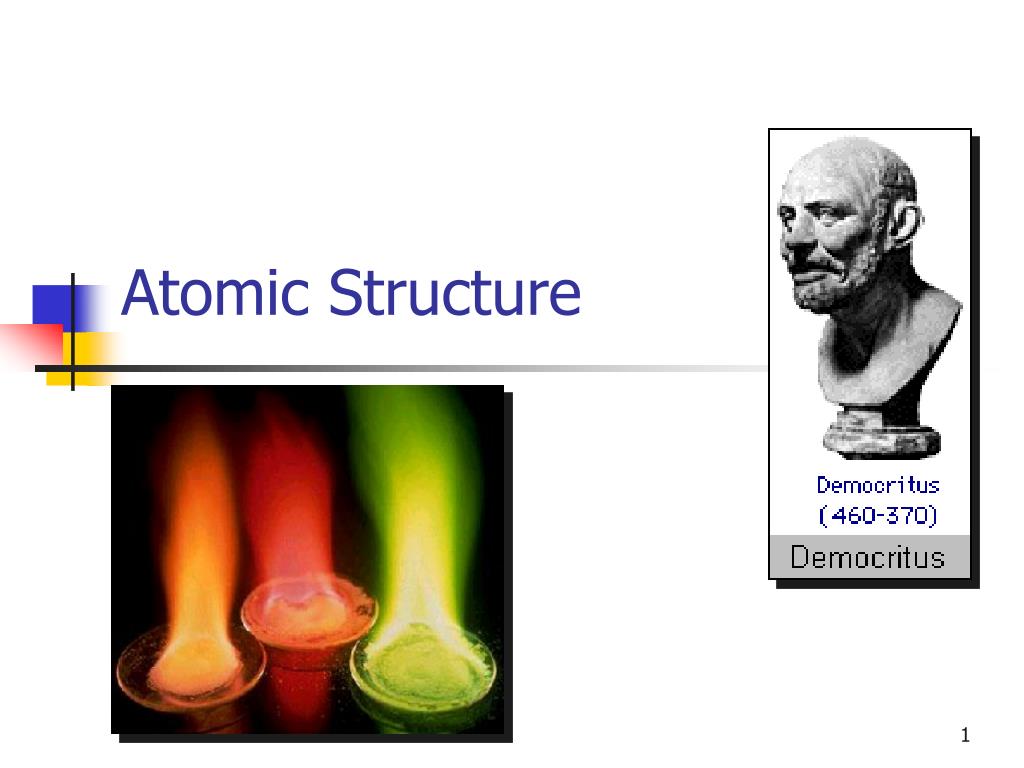
Atomic Structure. Discovery and Properties of Electrons. Humphrey Davy (early 1800’s) - passed electricity through compounds compounds decomposed into elements compounds are held together by electrical forces
Une image / un lien ci-dessous est fourni (tel quel) pour télécharger la présentation
Politique de téléchargement : le contenu du site vous est fourni TEL QUEL pour votre information et votre usage personnel ; il ne peut être vendu, concédé sous licence ni partagé sur d’autres sites sans l’accord de son auteur.Le contenu vous est fourni TEL QUEL, pour votre information et votre usage personnel uniquement.Téléchargez la présentation en cliquant sur ce lien.Lors du téléchargement, si vous ne parvenez pas à télécharger une présentation, l’éditeur a peut-être supprimé le fichier de son serveur.Pendant le téléchargement, si vous ne parvenez pas à obtenir une présentation, le fichier a peut-être été supprimé par l’éditeur.
Discovery and Properties of Electrons • Humphrey Davy (early 1800’s) - passed electricity through compounds • compounds decomposed into elements • compounds are held together by electrical forces • Michael Faraday - (1832-1833) - amount of reaction that occurs during electrolysis is proportional to current passed through compounds
Discovery of the Electron • J.J. Thomson proved the existence of the electron by showing that the beam in the Crookes tube experiments could be deflected when passed between two plates containing opposite charges.
Discovery of the Electron • Electrons carry the - charge since they come from the negative electrode and go to the positive electrode.
Discovery of the Electron • J.J. Thomson determined the e/m ratio by measuring the degree of deflection of cathode rays. e/m = 1.75882 x 10⁸ coulomb/g
Electron Mass • Millikan’s determination of the charge of an electron allowed for the determination of the mass of an electron.
Discovery of Proton • Rutherford shot a-particles at thin gold (Au) foil to see if they would be deflected. • Some a -particles were deflected back. • This could happen only if a highly concentrated + charge was deflecting the positively charged a-particle.
Atomic Theory • All nuclei contain protons. • Protons have a positive charge. • analyzed evidence from a-particle scattering • recognized existence of massive neutral particles - neutrons James Chadwick-1932
Mass Number & Isotopes • H.G. J. Moseley (1912-1914) - recognized that atomic number is the defining difference between elements • new understanding of Mendeleev’s periodic law
Atomic Theory • All atoms, except for hydrogen, also contain neutrons. • Neutrons do not have a charge.
Atom Composition The atom is mostly empty space • protons and neutrons in the nucleus. • the number of electrons is equal to the number of protons. • electrons in space around the nucleus. • extremely small. • One teaspoon of water has 3 times as many atoms as the Atlantic Ocean has teaspoons of water.
Composed of: protons neutrons electrons protons found in nucleus relative charge of +1 relative mass of 1.0073 amu Structure of the Atom
Composed of: protons neutrons electrons neutrons found in nucleus neutral charge relative mass of 1.0087 amu Structure of the Atom
Composed of: protons neutrons electrons electrons found in electron cloud relative charge of -1 relative mass of 0.00055 amu Structure of the Atom
How Large is an Atom? Scanning Tunneling Microscopic images of carbon atoms in graphite.
11B 10B Isotopes Two or more forms of atoms of the same element with different masses. Atoms contain the same number of protons but different numbers of neutrons. Boron-10 (10B) has 5 p and 5 n Boron-11 (11B) has 5 p and 6 n
12 6 12 C 6 Mass Number • Mass Number: total number of protons + neutrons (nucleons) in an atom. Mass Number = # protons + # neutrons mass number = 6 p + 6 n = 12 amu C number of protons Carbon-12,
# Neutrons = Mass Number - # Protons 13 12 14 C C C 6 6 6 Isotopes of Carbon 6 protons 6 protons 6 protons 12 - 6 = 6 13 - 6 = 7 14 - 6 = 8 6 neutrons 7 neutron 8 neutrons
31 P 15 Example • Consider a neutral atom of the element phosphorus: • Atoms of this element have how many protons in their nucleus? • How many electrons does a neutral atom of phosphorus have? • How many neutrons does an atom of phosphorus have in its nucleus? 15 15 16
40 Ca 20 Example • Consider a neutral atom of the element Calcium: • Atoms of this element have how many protons in their nucleus? • How many electrons does a neutral atom of calcium have? • How many neutrons does an atom of calcium have in its nucleus? 20 20 20
40 Ca2+ 20 Example • Consider a neutral atom of the element Calcium: • Atoms of this element have how many protons in their nucleus? • How many electrons does a neutral atom of calcium have? • How many neutrons does an atom of calcium have in its nucleus? 20 18 20
Atomic Weight • One amu is exactly 1/12 of the mass of a 12Catom. • 12C is a specific isotope of carbon. 1 g = 6.022 x 10²³ amu
∑ [( ) )] ( Atomic Weight fractional abundance isotopic mass x = Atomic Weight • The weighted average of the masses of its constituent isotopes.
Increased Deflection Mass Spectrometer Neon The natural relative abundances for different isotopes can be determined from the mass spectrum.
The atomic weight of carbon is 12.011 amu, computed as follows... • Atomic weight of C = the sum of (%abundance of isotope) x (its mass) for all stable isotopes. So... as percentages (98.89%)(12 amu) + (1.11%)(13.0034 amu) = or as fractions (0.9889)(12 amu) + (0.111)(13.0034 amu) = 12.011 amu
Mass Spectrometer Neon Atomic weight of Ne = (90.48%)19.9924 amu +(0.27%)20.9938 amu + (9.25%)21.9914 amu = (0.9048)*19.9924 amu +(0.0027)*20.9938 amu + (0.0925)*21.9914 amu = 20.1797 amu
Atomic Weight What is the average atomic weight of Mg? AW = 0.7899(23.98504) + 0.1000(24.98584) + 0.1101(25.98259) 24.30 amu
Atomic Weight • The atomic weight of Ga is 69.72; Ga-69 = 68.9257; Ga-71 = 70.9249 • What is the abundance of each isotope?
Atomic Weight Let x = abundance Ga-69 1-x = abundance of Ga-71 x(68.9257) + (1-x)(70.9249) = 69.72 68.9257x + 70.9249 – 70.9249x = 69.72 1.9992x = 1.20 x = 0.600 Ga-69 = 60.0% and Ga-71 = 40.0%
Electromagnetic Spectrum Visible light makes up only a small part of the electromagnetic spectrum.
Electromagnetic Spectrum • Electromagnetic radiation has a dual behavior. • It has properties of a particle called a photon and as a wave traveling at the speed of light. • Characterized by a wavelength and frequency.
Electromagnetic Radiation • Given n = 7.31 x 10¹⁴s-1, calculate l. = 4.10 x 10⁻⁷ m l = = 410 nm nm = 4.10 x 10⁻⁷ m
Planck’s Equation E = energy of 1 photon h = Planck’s constant, 6.626 x 10⁻³⁴ J-s n = frequency, s-1 l = wavelength, m c = speed of light, 3.00 x 10⁸ m/s
Quantization of Energy DE = h n Light with large l (small n) has a small E. Light with a short l (large n) has a large E.
Planck’s Equation • Calculate the energy of a photon with a wavelength of 4.10 x 10⁻⁷m. DE = 4.85 x 10⁻¹⁹ J
Quantum Theory • Allowed for the interpretation of spectra of atoms, ions, and molecules. • Neils Bohr proposed the fundamental hypothesis of the quantum theory.
Atomic Line Spectra and Niels Bohr • Bohr’s greatest contribution to science was in building a simple model of the atom. It was based on an understanding of the SHARP LINE SPECTRA of excited atoms. Niels Bohr (1885-1962)
Line Spectra of Excited Atoms • Excited atoms emit light of only certain wavelengths • The wavelengths of emitted light depend on the element.
Line Spectra of Excited Atoms • Visible lines in H atom spectrum are called the BALMER series. High E Short l High n Low E Long l Low n
Bohr Model of Atom • An atom has a number of definite and discrete energy levels in which an electron can exist. • Increasing radius of orbit increases the energy. • Electrons can move from one energy level to another. • Electron moves in circular orbit.
High Energy Orbit Low Energy Orbit Excited State Electron Ground State Energy The Bohr Model and Quantized Energy e- + Energies are “quantized” in other words the Energies are limited to discrete values. e-
Connexion au compte
Connectez-vous pour publier votre contenu sur SlideServe.