Download
1 / 13
130 likes | 246 Vues
Explore the essential structure of leaves and their role in photosynthesis. This overview covers the three external layers of a plant, the significance of stomata, and the internal features of leaves, including mesophyll cells and vascular tissues. Learn how the leaf's design, with its large surface area and specialized cells, optimizes light absorption and gas exchange. Discover the mechanisms of stomata controlled by guard cells and understand the process of photosynthesis occurring in chloroplasts. This comprehensive guide highlights crucial functions and adaptations essential for plant life.

E N D
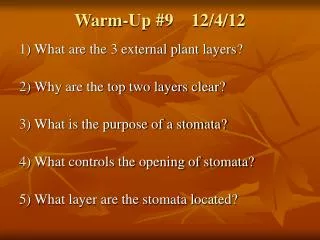
Warm-Up #9 12/4/12 1) What are the 3 external plant layers? 2) Why are the top two layers clear? 3) What is the purpose of a stomata? 4) What controls the opening of stomata? 5) What layer are the stomata located?
Leaf Structure Unit 5 Metabolism
Essential Question: What happens when leaves change color and fall to the ground? Objective Diagram the structure of a leaf Today is About…
Photosynthesis • Occurs in the chloroplast of the leaves • Leaf is thin • Very large surface area (ideal for diffusion/absorption). The larger the surface area the more sunlight can be absorbed. • Mesophyll cells are closer to the surface \ • reducing diffusion distance of CO2 from surrounding mesophyll cells
External Features • Waxy Cuticle • Top of leaf • Transparent • Allows light to enter for photosynthesis • Upper epidermal cells • Transparent • Allow light in to reach the chloroplast • Lower epidermis • Has stomata, which allows gas exchange (intake of CO2 and release of O2)
Stomata • Openings in the leaf • Controlled by doors called guard cells • Permit exchange of moisture and carbon dioxide between leaf and atmosphere
Internal Features • Vascular Tissue- found in leaf vein • Xylem • Top of leaf • Transports water to leaf cells and then it diffuses into chloroplast. • Phloem • Bottom of leaf • Transports food from mesophyll to rest of plant
Internal Features Cont. • Mesophyll- two main types • Palisade • Contain the most chloroplast • Found at top of leaf • Closely packed with small spaces in between to allow gas exchange • Spongy • Less chloroplast • Larger open spaces • Store carbohydrates made by photosynthesis
Internal Features Cont. • Chloroplast • Contain chlorophyll (WHERE PHOTOSYNTHESIS TAKES PLACE) • Double membrane that is selectively permeable • Allows H2O and CO2 to diffuse into it and O2 to diffuse out • Parenchyma • Rich in chloroplast • Primary site of photosynthesis in the leaf
http://academic.kellogg.edu/herbrandsonc/bio111/animations/0021.swfhttp://academic.kellogg.edu/herbrandsonc/bio111/animations/0021.swf Internal Features Cont… • Guard Cells • Controls the opening and closing of the stomata
Warm- Up #8 12/3/12 • What part of the plant are most chloroplast found in? • How is energy stored during photosynthesis • How is energy released during photosynthesis? • What is the product of the light dependent reaction? • What is the product of the light independent reaction?