Polygon Congruence
This guide provides an overview of congruent polygons, emphasizing congruent corresponding angles and sides. It explains how to identify corresponding parts in polygons using letters to denote vertices, such as CA corresponding to DO and angles

Polygon Congruence
E N D
Presentation Transcript
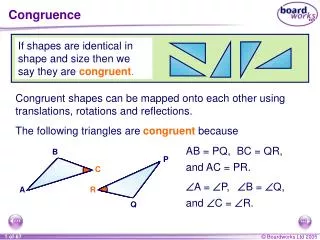
Congruent Polygons have… • Congruent Corresponding Angles • Congruent Corresponding Sides O A D G C T
Identify the Corresponding Parts Sides: • CA @ DO • AT @ OG • CT @ DG Angles: • <C @ <D • <A @ <O • <T @ <G O A G D C T
O A G D C T Congruency StatementAlign the corresponding parts /\CAT @/\DOG
Congruency StatementIdentify the congruent parts without a diagram KIND @ CALM
Congruency StatementIdentify the congruent parts without a diagram KIND @ CALM
Angles <K @ <C <I @ <A <N @ <L <D @ <M Sides KI @ CA IN @ AL ND@ LM KD@ CM KIND @ CALM
Write the congruency statement B X W E D Y A C V Z
pent ADBEC @ pent WXYZV B X W E D Y A C V Z