Lexical Analysis in Compiler Design: Building a DFA for Token Recognition in Scala
This exercise focuses on creating a lexical analyzer that utilizes a deterministic finite automaton (DFA) to recognize integer literals in Scala, covering decimal, hexadecimal, and octal forms. It involves constructing a DFA based on specific regular expressions, prioritizing binary and ternary tokens. Students will also explore the language of strings defined by specific regular expressions, practice tokenization, and understand the limitations of regular languages through examples. The exercise emphasizes foundational concepts of lexical analysis and automaton theory in compiler design.

Lexical Analysis in Compiler Design: Building a DFA for Token Recognition in Scala
E N D
Presentation Transcript
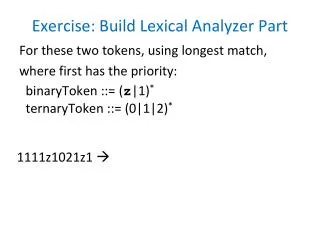
Exercise: Build Lexical Analyzer Part For these two tokens, using longest match, where first has the priority: binaryToken ::=(z|1)* ternaryToken ::= (0|1|2)* 1111z1021z1
Lexical Analyzer binaryToken ::=(z|1)* ternaryToken ::= (0|1|2)* 1111z1021z1
Exercise: Realistic Integer Literals • Integer literals are in three forms in Scala: decimal, hexadecimal and octal. The compiler discriminates different classes from their beginning. • Decimal integers are started with a non-zero digit. • Hexadecimal numbers begin with 0x or 0X and may contain the digits from 0 through 9 as well as upper or lowercase digits A to F afterwards. • If the integer number starts with zero, it is in octal representation so it can contain only digits 0 through 7. • l or L at the end of the literal shows the number is Long. • Draw a single DFA that accepts all the allowable integer literals. • Write the corresponding regular expression.
Exercise • Let L be the language of strings A = {<, =} defined by regexp (<|=| <====*), that is,L contains <,=, and words <=n for n>2. • Construct a DFA that accepts L • Describe how the lexical analyzer will tokenize the following inputs. 1) <===== 2) ==<==<==<==<== 3) <=====<
More Questions • Find automaton or regular expression for: • Sequence of open and closed parentheses of even length? • as many digits before as after decimal point? • Sequence of balanced parentheses ( ( () ) ()) - balanced ( ) ) ( ( ) - not balanced • Comment as a sequence of space,LF,TAB, and comments from // until LF • Nested comments like /* ... /* */ … */
Automaton that Claims to Recognize{ anbn | n >= 0 } Make the automaton deterministic Let the resulting DFA have K states, |Q|=K Feed it a, aa, aaa, …. Let qi be state after reading ai q0 , q1 ,q2 , ... , qK This sequence has length K+1 -> a state must repeat qi = qi+pp > 0 Then the automaton should accept ai+pbi+p . But then it must also accept aibi+p because it is in state after reading ai as after ai+p. So it does not accept the given language.
Limitations of Regular Languages • Every automaton can be made deterministic • Automaton has finite memory, cannot count • Deterministic automaton from a given state behaves always the same • If a string is too long, deterministic automaton will repeat its behavior
Pumping Lemma If L is a regular language, then there exists a positive integer p (the pumping length) such that every string sLfor which|s| ≥ p, can be partitioned into three pieces, s = x y z, such that • |y| > 0 • |xy| ≤ p • ∀i ≥ 0. xyizL Let’s try again: { anbn | n >= 0 }
Context-Free Grammars • Σ - terminals • Symbols with recursive defs -nonterminals • Rules are of form N ::= vv is sequence of terminals and non-terminals • Derivation starts from a starting symbol • Replaces non-terminals with right hand side • terminals and • non-terminals
Context Free Grammars • S ::= "" | a S b (for anbn) Example of a derivation S => => aaabbb Corresponding derivation tree:
Context Free Grammars • S ::= "" | a S b (for anbn) Example of a derivation S => aSb => a aSb b => aaaSb bb => aaabbb Corresponding derivation tree: leaves give result
Grammars for Natural Language can also be used to automatically generate essays Statement = Sentence "."Sentence ::= Simple | BeliefSimple ::= Person liking Person liking ::= "likes" | "does" "not" "like" Person ::= "Barack" | "Helga" | "John" | "Snoopy" Belief ::= Person believing "that" Sentence but believing ::= "believes" | "does" "not" "believe" but ::= "" | "," "but" Sentence Exercise: draw the derivation tree for: John does not believe that Barack believes that Helga likes Snoopy, but Snoopy believes that Helga likes Barack.
Balanced Parentheses Grammar • Sequence of balanced parentheses ( ( () ) ()) - balanced ( ) ) ( ( ) - not balanced Exercise: give the grammar and example derivation
Remember While Syntax program ::= statmt* statmt ::= println( stringConst , ident ) | ident = expr | if ( expr) statmt (else statmt)? | while ( expr ) statmt | { statmt* } expr ::= intLiteral| ident | expr (&& | < | == | + | - | * | / | % ) expr | ! expr | - expr
Eliminating Additional Notation • Grouping alternatives s ::= P | Q instead of s ::= P s ::= Q • Parenthesis notation expr (&& |< |==|+|-|*|/|%) expr • Kleene star within grammars { statmt* } • Optional parts if ( expr)statmt (elsestatmt)?
Id3 = 0 while (id3 < 10) { println(“”,id3); id3 = id3 + 1 } Compiler source code Compiler (scalac, gcc) id3 = 0LF w id3=0while(id3 <10) assign i 0 • < while • i parser • 10 lexer assign • + a[i] • 3 • * • 7 • i trees characters words (tokens)
Recursive Descent is Decent descent = a movement downward decent = adequate, good enough Recursive descent is a decent parsing technique • can be easily implemented manuallybased on the grammar (which may require transformation) • efficient (linear) in the size of the token sequence Correspondence between grammar and code • concatenation ; • alternative (|) if • repetition (*) while • nonterminal recursive procedure
A Rule of While Language Syntax statmt::= println ( stringConst , ident ) |ident = expr |if ( expr) statmt (else statmt)? |while ( expr ) statmt|{ statmt* }
Parser for the statmt(rule -> code) def skip(t : Token) = if (lexer.token == t) lexer.next else error(“Expected”+ t) // statmt ::= defstatmt = { // println ( stringConst , ident) if (lexer.token == Println) { lexer.next; skip(openParen); skip(stringConst); skip(comma); skip(identifier); skip(closedParen) // | ident = expr } else if (lexer.token== Ident) { lexer.next; skip(equality); expr // | if ( expr ) statmt (else statmt)? } else if (lexer.token == ifKeyword) { lexer.next; skip(openParen); expr; skip(closedParen); statmt; if (lexer.token == elseKeyword) { lexer.next; statmt } // | while ( expr ) statmt
Continuing Parser for the Rule // | while ( expr ) statmt } else if (lexer.token == whileKeyword) { lexer.next; skip(openParen); expr; skip(closedParen); statmt // | { statmt* } } else if (lexer.token == openBrace) { lexer.next; while (isFirstOfStatmt) { statmt } skip(closedBrace) } else { error(“Unknown statement, found token ” + lexer.token) }
First Symbols for Non-terminals statmt ::= println ( stringConst , ident ) | ident = expr | if ( expr ) statmt (else statmt)? | while ( expr ) statmt | { statmt* } • Consider a grammar G and non-terminal N LG(N) = { set of strings that N can derive } e.g. L(statmt) – all statements of while language first(N) = { a | aw in LG(N), a – terminal, w – string of terminals} first(statmt) = { println, ident, if, while, { } (we will see how to compute first in general)
Compiler Id3 = 0 while (id3 < 10) { println(“”,id3); id3 = id3 + 1 } Construction source code Compiler (scalac, gcc) id3 = 0LF w id3=0while(id3 <10) assign i 0 • < while • i parser • 10 lexer assign • + a[i] • 3 • * • 7 • i trees characters words (tokens)
Trees for Statements statmt ::= println ( stringConst , ident ) | ident = expr | if ( expr ) statmt (else statmt)? | while ( expr ) statmt | { statmt* } abstract class Statmt case class PrintlnS(msg : String, var : Identifier) extendsStatmt case class Assignment(left : Identifier, right : Expr) extendsStatmt case class If(cond : Expr, trueBr :Statmt, falseBr : Option[Statmt]) extendsStatmt caseclass While(cond : Expr, body : Expr) extendsStatmt caseclass Block(sts : List[Statmt]) extendsStatmt
Our Parser Produced Nothing def skip(t : Token) : unit = if (lexer.token == t) lexer.next else error(“Expected”+ t) // statmt ::= defstatmt:unit = { // println ( stringConst , ident) if (lexer.token == Println) { lexer.next; skip(openParen); skip(stringConst); skip(comma); skip(identifier); skip(closedParen) // | ident = expr } elseif (lexer.token== Ident) { lexer.next; skip(equality); expr
Parser Returning a Tree def expect(t : Token) : Token = if (lexer.token == t) { lexer.next;t} else error(“Expected”+ t) // statmt ::= defstatmt: Statmt = { // println ( stringConst , ident) if (lexer.token == Println) { lexer.next; skip(openParen); val s = getString(expect(stringConst)); skip(comma); val id = getIdent(expect(identifier)); skip(closedParen) PrintlnS(s, id) // | ident = expr } elseif (lexer.token.class== Ident) { val lhs = getIdent(lexer.token)lexer.next; skip(equality); val e = expr Assignment(lhs, e)
Constructing Tree for ‘if’ defexpr: Expr = { … } // statmt ::= defstatmt: Statmt = { … // if ( expr ) statmt (else statmt)? //case class If(cond : Expr, trueBr: Statmt, falseBr: Option[Statmt]) } elseif (lexer.token == ifKeyword) { lexer.next; • skip(openParen); val c = expr; skip(closedParen); • valtrueBr = statmt • valelseBr = if(lexer.token == elseKeyword) { • lexer.next; Some(statmt) } else Nothing • If(c, trueBr, elseBr) // made a tree node • }
Task: Constructing Tree for ‘while’ defexpr: Expr = { … } // statmt ::= defstatmt: Statmt = { … // while ( expr ) statmt // case class While(cond : Expr, body : Expr) extends Statmt } else if (lexer.token == WhileKeyword) { } else
Here each alternative started with different token statmt ::= println ( stringConst , ident ) | ident = expr | if ( expr ) statmt (else statmt)? | while ( expr ) statmt | { statmt* } What if this is not the case?
Left Factoring Example: Function Calls statmt ::= println ( stringConst , ident ) | ident = expr | if ( expr ) statmt (else statmt)? | while ( expr ) statmt | { statmt* } | ident (expr(, expr)* ) foo = 42 + x foo ( u , v ) code to parse the grammar: } elseif (lexer.token.class == Ident) { ??? }
Left Factoring Example: Function Calls statmt ::= println ( stringConst , ident ) | identassignmentOrCall | if ( expr ) statmt (else statmt)? | while ( expr ) statmt | { statmt* } assignmentOrCall ::= “=“ expr | (expr(, expr)* ) code to parse the grammar: } elseif (lexer.token.class == Ident) { val id = getIdentifier(lexer.token); lexer.next assignmentOrCall(id) } // Factoring pulls common parts from alternatives