Download
1 / 3
30 likes | 153 Vues
This article discusses the Republic of Korea's (ROK) firm opposition to Japan's proposal to amend Article 9 of its Peace Constitution, which renounces war and military forces. Concerns over Japan's military resurgence, coupled with unresolved historical grievances from World War II, fuel ROK's distrust. The article explores ROK's diplomatic strategies, including lobbying the U.S. to pressure Japan, increasing military-to-military relations for transparency, and negotiating contentious territorial issues. It highlights apprehensions about potential changes in military agreements and the historical context surrounding these discussions.

E N D
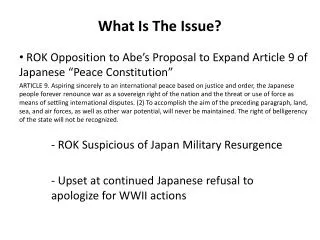
What Is The Issue? ROK Opposition to Abe’s Proposal to Expand Article 9 of Japanese “Peace Constitution” ARTICLE 9. Aspiring sincerely to an international peace based on justice and order, the Japanese people forever renounce war as a sovereign right of the nation and the threat or use of force as means of settling international disputes. (2) To accomplish the aim of the preceding paragraph, land, sea, and air forces, as well as other war potential, will never be maintained. The right of belligerency of the state will not be recognized. - ROK Suspicious of Japan Military Resurgence - Upset at continued Japanese refusal to apologize for WWII actions
Lobby US to pressure Japan not to change constitution • Increased mil-to-mil relations w/Japan to decrease apprehension • Good faith negotiations to resolve Dokdo/Takeshimaissue • - Possible Administrative Island Sharing? Potential ROK Policies to Address Issue
Least Likely • - Cut off diplomatic ties • Could Happen • - Collective Self-Defense Agreement with Japan • Most Likely • - Increased mil-to-mil exchanges to provide transparency to Japanese intentions Possible ROK Courses of Actions