

SlideServe
Menu
Préférences
© SlideServe · v2026

Anime

berit avatar
12 diapositives · 1K Views · Jul 17, 2014

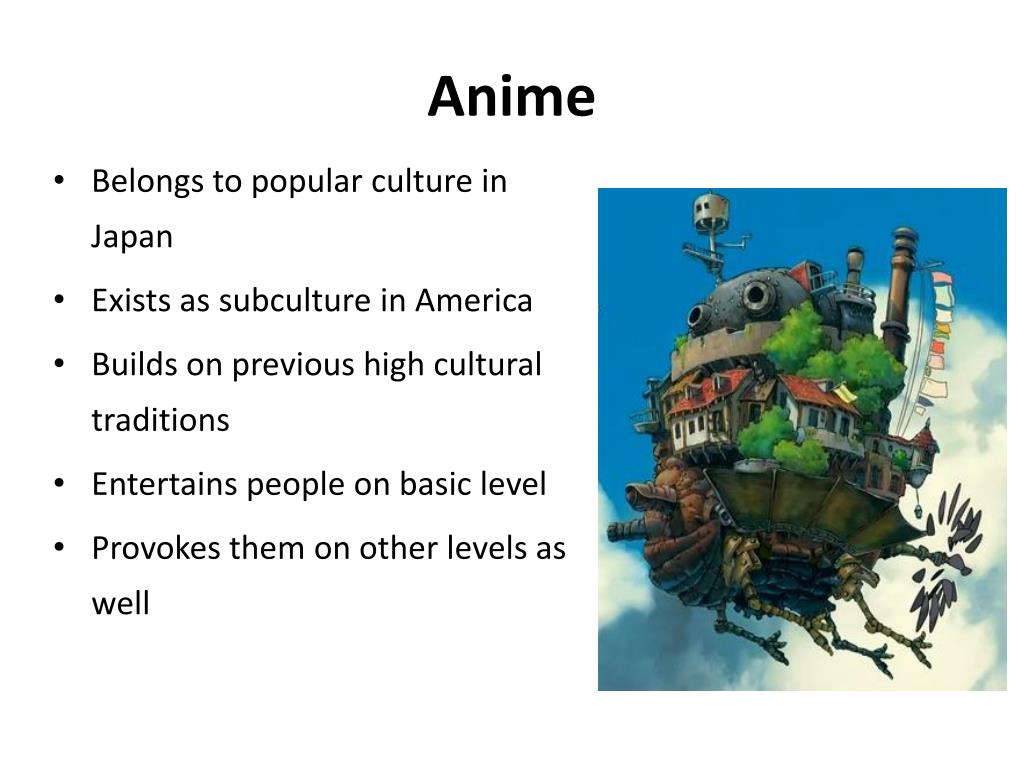
Anime. Belongs to popular culture in Japan Exists as subculture in America Builds on previous high cultural traditions Entertains people on basic level Provokes them on other levels as well. History of anime. 1909: Western animated film appeared in Japan
Anime - slide 1
01 / 12Anime
1 / 17

Télécharger la présentation

Anime
Une image / un lien ci-dessous est fourni (tel quel) pour télécharger la présentation

Politique de téléchargement : le contenu du site vous est fourni TEL QUEL pour votre information et votre usage personnel ; il ne peut être vendu, concédé sous licence ni partagé sur d’autres sites sans l’accord de son auteur.Le contenu vous est fourni TEL QUEL, pour votre information et votre usage personnel uniquement. Téléchargez la présentation en cliquant sur ce lien. Lors du téléchargement, si vous ne parvenez pas à télécharger une présentation, l’éditeur a peut-être supprimé le fichier de son serveur.Pendant le téléchargement, si vous ne parvenez pas à obtenir une présentation, le fichier a peut-être été supprimé par l’éditeur.

F I N

Plus de contenu associé

Transcription de la présentation
  1. Anime • Belongs to popular culture in Japan • Exists as subculture in America • Builds on previous high cultural traditions • Entertains people on basic level • Provokes them on other levels as well

  2. History of anime • 1909: Western animated film appeared in Japan • 1915: Japanese animations(like Toei) started create their own works • 1963: First Japanese animated television series- Astro Boy (by Osamu Tezuka) • Early 1980s: anime became an important player in video market • 1988: Around 40% of Japanese studio releases were animated • 1999: 50% of them were animated

  3. American Responses to Manga and Anime • Difficulties • Responses from fans of Japanese mange and anime (Point of views of both American comics and Japanese manga) • Responses from American parents of small children

  4. Manga in Japan • Manga culture • Manga use in Education, Commercial and Political purposes • Reason of popular culture of manga

  5. Finding Self Through The Works of Manga and Anime • Manga provides role models • Older education system • Contemporary educational system • Students establishing individual selves and personalities • Manga helps on students growth

  6. Anime: SUPERHEROES • Sailor Moon was first introduced in 1992 in Japan. • Female heroes were rare in Japan. • Expand market to include girls. • Sailor Moon was popular in Asian countries instead of the Western countries.

  7. Power Rangers • Originated from a show in Japan named “Go Ranger”. • Great success of the new version of Rangers in U.S. • Translate to fit taste of Americans.

  8. Sailor Moon • Story of the various metaseries revolves around the reborn defenders of a kingdom that once spanned the Solar System and the evil forces that they battle. • Major characters — Sailor Scouts are teenage girls who can transform into heroines named for the Moon and planets. • Use of "Sailor" comes from a style of girls' school uniform popular in Japan, the sērāfuku (Sailor outfit).

  9. The reasons that make feminist heroes popular in Japan • The increases in female manga artists in recent years. • The large consumer audience of girls. • More girls who read, watch and even write their own fantasy stories. • A numeral of ojisan (older men) like Sailor Moon as she has a good figure.

  10. Reasons that Sailor Moon failed in United States • DIC Entertainment gives fuller attention of male superhero. • Spent the larger expenditures on Dragon Ball Z and Masked Rider of advertisement in Kid’s prime time. • Girl watch male-oriented programming but boys won’t watch female-oriented shows in America. • Not altered sufficiently of “cultural appropriate”.

  11. Discussion • What are the factors that made Japanese anime not succeed in the U.S. market? • What are the reasons behind anime’s popularity in Japan? • Why girly heroes are popular in Japanese, but not in United State? • How do you think about the statement ‘Sailor Moon is the one which makes for a new and attractive combination of the action orientation of boys and fashion orientation of girls.’? • Why Japanese culture appeal to so many Americans?

  12. Reference List Allison, Anne. “Sailor Moon: Japanese Superheroes for Global Girls.” Chap.14 in Japan Pop!: Inside the World of Japanese Popular Culture, ed. Timothy J. Craig. New York: M.E. Sharpe, 2000, 259-78. Hatayama, Hiroaki. “The Cross-Cultural Appeal of the Characters in Manga and Anime.” In The Japanification of Children’s Popular Culture: From Godzilla to Miyazaki, ed., Mark I. West. Lanham, Marylnad: The Scarecrow Press, 2009, 191-98. Napier, Susan J. “Anime from Akira to Howl’s Moving Castle.” In Experiencing Contemporary Japanese Animation. Palgrave Macmillan, 2005, 1-34.