The Moche Civilization: Insights into Prehistoric Andean States and Their Cultural Legacy
The Moche civilization, thriving in prehistoric Andean valleys, is a remarkable study of early state formation. With 30,000 hectares in the North Valley and 15,000 in the South, their semitropical environment supported diverse agriculture, including Andean crops and coastal seafood. Sites like Cerro Blanco and Huaca del Sol reveal sophisticated social organization, extensive irrigation, and militarized expansion. Ritual practices, including sacrifices, shaped their ideology, exemplified by the Lord of Sipán tomb with extraordinary burial offerings. The Moche's rich pottery and iconography showcase their cultural complexity.

The Moche Civilization: Insights into Prehistoric Andean States and Their Cultural Legacy
E N D
Presentation Transcript
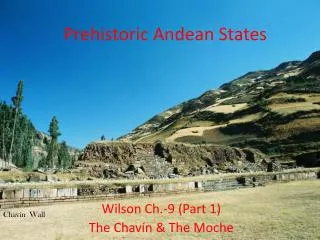
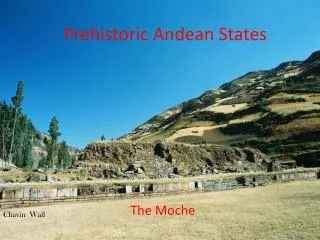
Prehistoric Andean States The Moche Chavín Wall
The Moche • Physical Environment • North Valley- 30,000 hectares of irrigable land • South Valley- 15,000 hectares of irrigable land • Semitropical environment • Fauna: parrots, toucans, pumas, iguanas, & boas. • Represented in the iconography of pottery vessels
The Moche • Mode of production • Agriculture- Andean crops began by 1800B.C. • Coast crops: maize, roots, and tubers, legumes, fruits, cucurbits and chili peppers and cotton. (Plus seafood) • Settlement Pattern • Cerro Blanco- primary center’s site (Moche capital • Huaca del Sol • Huaca de la Luna • personalized columns or walls per each community who built it • Functions of the Huacas
The Moche • Mode of Reproduction • 5,000-20,000 people earliest periods • Estimated population= 650,000 people • Domestic Economy & Social Organization • Wattle-and-daub quinchastructures • Two main rooms • Evidence of an artisans class • Specialized craft production found among states. • Figure 9.17 b
The Moche Political Economy • Military segmentation for resistance • Moche military expansion & conquest • HuacaTembladera • Centralized power • Similar personalized marks as in Huasca del Sol • Ruled by Mocheadministratos and elite • Moche state imposed style of pottery making, pyramid construction and administrative policies • Iconography depicts collection of tribute and P.O.W.s • Warfare, conquest and coercive control
The Moche • Ritual, Leadership, and State Ideology • Created a powerful ideology, which permeated • P.O.W. were sacrificed and their blood was handed to priests as offerings. • Religion as means of social control
Lord of Sipán • Tomb I- largest burial offering of prehispanic vessels ever found • Copper bells and backflaps- Decapitator deity • Burial included: • Hundreds of pottery vessels • 2 sacrificed llamas • A small child • 5 coffins, one warrior missing a his feet • Women, all secondary burials from elsewhere not sacrificed there
A Model of Moche State Policy • Superstructure • Ideology • Ritual/leadership • Structure • Social organization • Political economy • Infrastructure • Mode of production • Settlement pattern