Understanding the Circulatory System: Structure and Functions in Humans and Animals
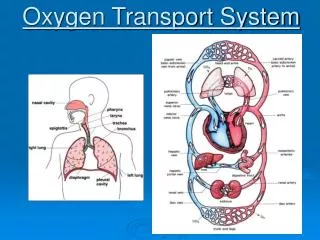
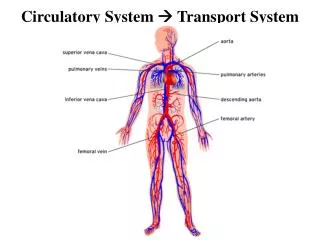
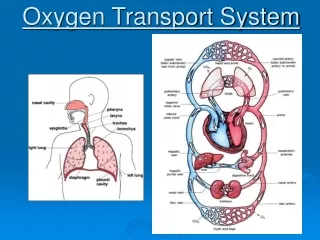
The circulatory system is essential for transporting substances such as nutrients, water, and oxygen throughout the body. It consists of three main components: a medium (blood in humans and haemolymph in insects), vessels, and a pump (heart). Blood, composed of plasma and cellular elements including red and white blood cells, serves to carry oxygen and carbon dioxide, while also performing various functions such as waste removal and immune defense. This system is critical for maintaining homeostasis and facilitating communication between body cells.

Understanding the Circulatory System: Structure and Functions in Humans and Animals
E N D
Presentation Transcript
TRANSPORT SYSTEM The Concept of Circulatory System Rez@SB2014
Circulatory system: • Transports substances continuously around the entire body • Transports nutrients, water & O2 to body cells • Remove CO2 and other nitrogenous wastes from body cell • Consists of 3 components: • Medium • Vessels • Pump A) Circulatory System In Human & Animals Rez@SB2014
Required to carry materials around the circulatory system • In human & animals : BLOOD • Insects : HAEMOLYPMH • Composition of human blood • PLASMA – 55% • CELLULAR ELEMENTS – 45 % a) MEDIUM / FLUID Rez@SB2014
RED BLOOD CELLS • 5 million per mm3 of blood • DO NOT HAVE : • Nucleus • mitochondria • ribosomes • Full of haemoglobin to bind O2 & CO2 • Made in bone marrow • live for about 120 days • Destroyed & recycled in liver (i) Erythrocytes Rez@SB2014
HAVE NO NUCLEUS : provide more space for haemoglobin • Haemoglobin transports O2 – combined as oxyhaemoglobin – from lungs to the body tissues for respiration • Also carry CO2 as hydrogen-carbonate from the respiring tissues to the lungs • BICONCAVE DISC- SHAPED CELLS : increase the TSA/V ratio for optimum gaseous exchange • SMALL & FLEXIBLE: able to squeeze through narrow capillary walls Adaptations : Rez@SB2014
leucocytes Rez@SB2014
WHITE BLOOD CELLS • Colorless • Χ hemoglobin • Larger than erythrocytes; fewer in number • ≈ 7000 per mm3of blood • No fix shape • have nucleus • Can change their shapes & squeeze through the walls of capillaries • Important in body mechanisms against disease Rez@SB2014
Have : • granular cytoplasm • lobed nucleus • Capable of amoeboid movement • engulf bacteria by phagocytosis • Produced in bone marrow a) Granulocytes Rez@SB2014
Phagocytosis by Granulocyte Rez@SB2014
b) Agranulocytes Have non-granular cytoplasm and a compact nucleus Rez@SB2014
The largest of the five types of white blood cell • Produce in bone marrow • Have bean-shaped nucleus • Ingest bacteria by phagocytosis a) Monocytes Rez@SB2014
has large rounded nucleus • contains many genes : efficient antibody protein productions • Produced in the lymph glands & the lymphatic nodes • FUNCTIONS: • Produce antibodies • specific defense against toxins produced by bacteria and infecting germs b) Lymphocytes Rez@SB2014
thrombocytes Rez@SB2014
PLATELETS • Not cells • tiny fragments of other cells (megakaryocytes) • Colorless, irregular shape, without nucleus • Made in bone marrow • last about 6-7 days (iii) Thrombocytes Rez@SB2014
FUNCTIONS: • Have amoeboid movements • Important in blood clotting & repairing damages tissues • Help to maintain the integrity of blood vessel wall (iii) Thrombocytes Rez@SB2014
Blood plasma Rez@SB2014
Yellowish liquid • Serum : blood plasma with its clotting factors (such as fibrin) removed • 90% water, 10% dissolved substances (iv) Plasma Rez@SB2014
consist of dissolved gases, absorbed food molecules, excretory waste products, hormones & salts • Heat produced by respiration absorbed by plasma (iv) Plasma Rez@SB2014
Transport O2 • Transport CO2 • Transport absorbed food materials • Transport of excretory waste products • Deamination excess amino acids occur in liver • Transport heat • Blood distribute heat from heat-producing sites (e.g. skeletal muscles) to areas of heat loss (e.g. skin) • Transport of hormones • Transport of water to tissues b) Functions of blood Rez@SB2014
hAEMOLYMPH Rez@SB2014
Haemolymph : • the circulatory fluid in body cavities of insects • A.K.A ‘ insect blood’ • Flows freely within the body cavity • makes direct contact with all the internal tissues & organ of insects • Contains water, amino acids, sugar, salts & white cell c) Function of Haemolymph in Transport Rez@SB2014
Haemolymph : • the circulatory fluid in body cavities of insects • Transport hormones, nutrients, salt & metabolic wastes around the body • Does not contain haemoglobin or RBC • Does not transport O2 and CO2 c) Function of Haemolymph in Transport Rez@SB2014
Open and closed circulatory system Rez@SB2014
Insects, crustaceans & mollusks • Heart pumps haemolymph through the aorta which branches into number of arteries that open into body cavity • Haemolymph • reaches the body cells directly • diffuses between body cells & re-enters the heart through open-ended veins Open circulatory system Rez@SB2014
Found in all vertebrates & some invert (e.g. earthworms) • Heart pumps blood rapidly through & within completely closed continuous system of vessel • never comes in direct contact with body cells Closed circulatory system Rez@SB2014
The Structure of Human Blood Vessels Rez@SB2014
Heart is connected to a series of tubes called blood vessels • BLOOD VESSELS: • Tubes for the medium to flow through • Main types of vessels: artery, arteriole, capillary, venule and vein • Each type of blood vessel has a different structure according to their function Rez@SB2014
Vessels Rez@SB2014