Understanding Static Electricity: Causes, Effects, and Properties Explained
Static electricity is the buildup of electrical charges on the surface of materials, typically occurring when they are rubbed together or pulled apart, resulting in a surplus of positive or negative charges. This phenomenon is common in insulators and non-conductors, known as "static" because there's no current flow. Causes include the loss or gain of electrons, with effects such as attraction, repulsion, and sparks. Opposite charges attract, same charges repel, and dry air enhances these interactions due to its molecular properties.

Understanding Static Electricity: Causes, Effects, and Properties Explained
E N D
Presentation Transcript
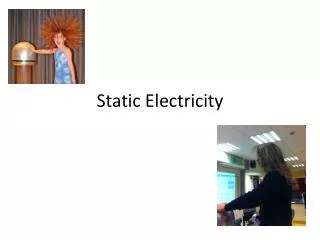
What is it? • Static electricity is the buildup of electrical charges on the surface of some object or material. • Static electricity is usually created when materials are pulled apart or rubbed together, causing positive (+) charges to collect on one material and negative (−) charges on the other surface.
Description of static electricity • Static electricity is the accumulation of electrical charges on the surface of a material, usually an insulator or non-conductor of electricity. • It is called “static” because there is no current flowing
Description of Static Electricity Attraction: • When one has an excess of electrons or negative (−) charges on its surface and the other material having an excess of positive (+) electrical charges.
Description of Static Electricity • Ground: If one of the materials is an electrical conductor that is grounded they will drain off
Causes of Static Electricity • Positive charge: loses electrons ends up with an excess of positive (+) • Negative Charge: The material gains electrons ends up an excess of negative (−) charges on its surface.
Dry air preferred • Dry air is bestbecause of the shape of water molecules
Properties or effects of static electricity • Attract • Repel • Spark
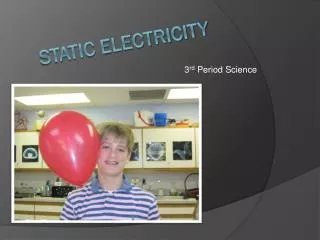
Attraction vs repulsion • Opposite charges attract and same charges repel. • Either charge will be attracted to something of neutral charge.
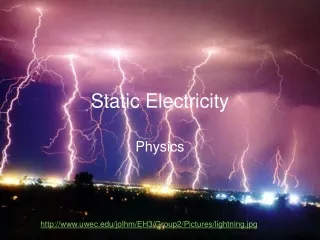
Sparks • If there are enough positive (+) electrical charges on one object or material and enough negative (−) charges on the surface of the other object the attraction between the charges jump the air gap and heating the air for a fraction of a second.