
Evidence for Evolution
E N D
Presentation Transcript
Review of Natural Selection Evidence for Evolution
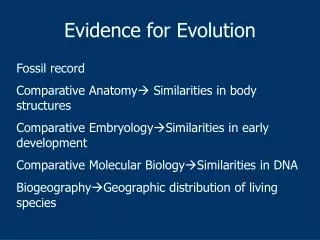
Evidence for Evolution Evidence for Evolution • Darwin argued that living things have been evolving on Earth for millions of years. • Evidence for this can be found in • Fossil Records • Geographic distribution of living things • Homologous structure of organisms • Similarities during development or (embryology)
Evidence for Evolution • 1. Fossil evidence provides an incomplete record of early life. • Fossilscan include any evidence of life, such as imprints and remains of organisms.
Evidence for Evolution • This evidence must be interpreted to form an overall picture of how species changed over time (evolved) • By examining the fossil record, scientists have concluded that evolution happens in a simple to complex pattern and life emerged from sea to land.
Evidence for Evolution • Fossils must be dated to help establish a time frame for the existence of a species. • There are two methods of determining the age of fossils.
Evidence for Evolution • Inrelative datingthe exact age of the fossil cannot be determined, only the order of appearance as compared to other fossils found in nearby rocks. • Fossils occur in layers of sedimentary rock. • The fossils near the top will be more recent than fossils in lower layers of rock.
Fill It In … Explanation of the fossil diagram:
Evidence for Evolution • Radioactive datinggives a more exact age using the natural decay of radioactive isotopes in organisms.
Evidence for Evolution • 2. Biochemical similaritiesinclude comparisons of DNA and the resulting amino acid sequences for certain, shared proteins. • This is considered one of the most reliable and objective types of evidence used to determine evolutionary relationships.
Evidence for Evolution • In general, the fewerdifferences found between two species, the closer the evolutionary relationship.
Fill It In … Explanation of the amino acid sequence diagram:
Evidence for Evolution • 3. Shared anatomical structures supports some type of evolutionary relationship.
Evidence for Evolution • Structures with a similar bone arrangement are called homologous structures. • A similar bone arrangement, even if the functions are different, supports evidence from a common ancestor.
Homologous Structures • Homologous Structures- different mature forms but develop from the same embryonic tissue • Similar function • Found on different species • Thought to be inherited by a common ancestor
Comparative Anatomy • Vestigial organs- are no longer used by the organism • Have shrunk in size • May only be a trace left behind • Why? • Example- Whale Hip, Human tail bone
Comparative Anatomy • Analogous structure- Similar function • Found in different species • Inherited by a DIFFERENT ancestor
Fill It In … Explanation of the bone diagram:
Evidence for Evolution • Structures that perform the same function (ex. flying) but are very different anatomically (ex. bird wing vs. butterfly wing) are called analogous structures. • This supports evolution in similar habitats though not from a recent common ancestor
Evidence for Evolution • Vestigialstructures (ex. Appendix or tail bone in human) are not functional in that organism, but may represent a link to a previous ancestor.
Fill It In … Example of vestigial structure:
Embryology • Embryology- is an organisms development • ALL vertebrate embryos have gill pouches- thought to be inherited from a common ancestor • Embryonic tissue develop in the same order http://www.pbs.org/wgbh/evolution/library/04/2/l_042_02.html
Check Yourself! • Name the two methods by which fossils may be dated. • How do biochemical similarities support the theory of evolution? • What does similar bone structure (even if the function is different) suggest about two species?
Check Yourself! • Name the two methods by which fossils may be dated. RELATIVE DATING & RADIOACTIVE DATING • How do biochemical similarities support the theory of evolution? • What does similar bone structure (even if the function is different) suggest about two species?
Check Yourself! • Name the two methods by which fossils may be dated. RELATIVE DATING & RADIOACTIVE DATING • How do biochemical similarities support the theory of evolution? FEWER DIFFERENCES = CLOSER EVOLUTIONARY RELATIONSHIP • What does similar bone structure (even if the function is different) suggest about two species?
Check Yourself! • Name the two methods by which fossils may be dated. RELATIVE DATING & RADIOACTIVE DATING • How do biochemical similarities support the theory of evolution? FEWER DIFFERENCES = CLOSER EVOLUTIONARY RELATIONSHIP • What does similar bone structure (even if the function is different) suggest about two species? EVOLUTION FROM A COMMON ANCESTOR
Does evolution still happen today? • As long as variation, overproduction, competition, natural selection and mutations occur, evolution will occur. • Because evolution leading to speciation happens over such a long period of time, speciation is not readily observable within a lab.
Does evolution still happen today? • Natural selection, one of the main mechanisms of evolution, is observable in some populations. • For example, the evolution of resistance to chemicals: Resistance- Standard Resistance -TedTalk
Does evolution still happen today? • Farmers use pesticides to eliminate insects. • In a population of insects, some individuals will possess genetic immunity to certain chemicals.
Does evolution still happen today? • When the chemicals are applied, the individuals with genetic immunity will survive and reproduce, passing this resistance to the next generation of offspring. • Over time, more individuals are born with this immunity, rendering the pesticide useless.
Does evolution still happen today? • Antibiotics are drugs that fight bacterial infections. • Within any population there is genetic variation. • In the case of antibiotic resistance, some bacteria are genetically more resistant to the antibiotic than other bacteria
Does evolution still happen today? • If the amount of antibiotic delivered is too low or the full course not completed, only those least resistant will die. • The surviving, resistant bacteria will reproduce.
Does evolution still happen today? • With future applications of antibiotics the population is selected to become more and more resistant. • The overuse of antibiotics has led to many resistant strains of bacteria. Antibiotic resistance Brainpop- antibiotic resistance
Fill It In … Definition of antibiotic resistance: CAUSE of resistance: EFFECT of resistance:
CAN WE SEE EVOLUTION? 1. YES! Antibiotics are good for ridding us of bacteria but are agents of natural selection. They select out of a population the weaker bacteria while the more resilient (mutant) bacteria survive and reproduce. This can occur b/c some have medicine destroying enzymes or eat the drug as food. Some TB causing bacteria are resistant to all three drugs developed. http://www.pbs.org/wgbh/evolution/library/10/4/l_104_07.html http://www.pbs.org/wgbh/evolution/library/10/4/l_104_09.html http://www.pbs.org/wgbh/evolution/library/01/1/l_011_20.html
Check Yourself! • What is a pesticide? • Why do some insects become resistant to pesticides? • What is an antibiotic? • What has led to the many resistant strains of bacteria?
Check Yourself! • What is a pesticide? CHEMICAL USED TO ELIMINATE PESTS • Why do some insects become resistant to pesticides? • What is an antibiotic? • What has led to the many resistant strains of bacteria?
Check Yourself! • What is a pesticide? CHEMICAL USED TO ELIMINATE PESTS • Why do some insects become resistant to pesticides? SOME POSSESS GENETIC IMMUNITY TO CERTAIN CHEMICALS • What is an antibiotic? • What has led to the many resistant strains of bacteria?
Check Yourself! • What is a pesticide? CHEMICAL USED TO ELIMINATE PESTS • Why do some insects become resistant to pesticides? SOME POSSESS GENETIC IMMUNITY TO CERTAIN CHEMICALS • What is an antibiotic? DRUG THAT FIGHTS BACTERIAL INFECTIONS • What has led to the many resistant strains of bacteria?
Check Yourself! • What is a pesticide? CHEMICAL USED TO ELIMINATE PESTS • Why do some insects become resistant to pesticides? SOME POSSESS GENETIC IMMUNITY TO CERTAIN CHEMICALS • What is an antibiotic? DRUG THAT FIGHTS BACTERIAL INFECTIONS • What has led to the many resistant strains of bacteria? THE OVERUSE OF ANTIBIOTICS