Understanding Genome Changes: Mutations and Their Evolutionary Significance
This text delves into various aspects of genomic changes, highlighting mutations including chromosomal alterations and DNA sequence changes. It discusses the implications of mutation rates, such as their role in evolution and the diversity of alleles. Key topics include different types of mutations—chromosomal mutations like aneuploidy and polyploidy, as well as DNA mutations such as missense and nonsense mutations. The impact of founder mutations on populations and the significance of pseudogenes in evolutionary history are also examined, providing insights into genetics and molecular evolution.

Understanding Genome Changes: Mutations and Their Evolutionary Significance
E N D
Presentation Transcript
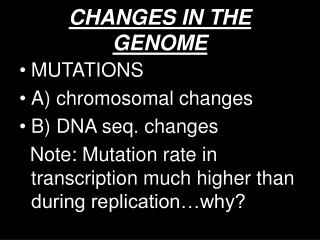
CHANGES IN THE GENOME • MUTATIONS • A) chromosomal changes • B) DNA seq. changes Note: Mutation rate in transcription much higher than during replication…why?
New source of alleles variety • Double-edged sword! • Can be used to trace evolutionary history
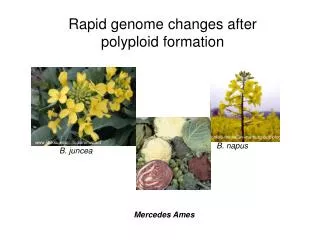
ANEUPLOIDY – MISSING/EXTRA CHROM. • POLYPLOIDY – EXTRA SETS ie. P. Kewensis 2N = 36 from hybridization (2N = 18)
Translocation – relocation of groups of base pairs from one part of the genome to another (usually bet. 2 non-homologous chromosomes…can lead to leukemia)
Autosomal Condition Huntington’s – chromosome 4 Normal allele 6-35 CAG repeats Huntington’s 40-150+ CAG repeats • Causes Neurodegeneration • Blocks acetyl-transferases in brain cells (reg. gene expression)
X-linked • Fragile X syndrome • CGG repeats 200-1000 times vs 50X for norm Leads to mental retardation (abnormal nerve cell dendrites)
DNA MUTATIONS • SILENT – same amino acid • MISSENSE – diff’t a.a. • NONSENSE – stop codon • FRAMESHIFTING
Missense Sickle cell anemia Base pair sub GAG (Glu) changed to GTG (Val) … Or Nonsense lethal (base pair sub)
RAS mutation • 12th codon in DNA GGC gen Gly Mutant 12th codon GTC gen Val Affects RAS’s ability to hydrolzye GTP to GDP...Sig?
Deletion – removal of 1 or more bp (leads to frameshifting …very serious) • Insertion – addition of 1 or more bp (see above)
Transposons-Barbara McClintock • Are moveable genetic elements. • DNA sequence can jump into a gene rendering it inactive • Contain enzyme transposase. • Most are retrotransposons (use reverse transcriptase to conv. mRNA to DNA for incorporation into the gene) • Ie 800 bp insertion in starch-related enzyme in peas “wrinkling”
PSEUDOGENES • “false” or “dead genes” • Produced 2 ways: a) during division an extra copy is inserted into genome in a new location b) reverse transcription
Reverse transcription • Retrotransposition is the insertion of DNA into Genome • Carried out by LINES (long interspersed nuclear elements) that sweep up DNA and mRNA (then retrotransposed) for insertion into genome
RPL21 • Ribosome Protein family = 80 genes • RPL21 140 pseudogenes
Genes become pseudogenes if they incur: • Loss of promoter • Loss of introns • Mutations in the gene (deletions, insertions, non-sense)
GULO Pseudogene • Functional in rodents • Nonfunctional in primates • GULO makes an enzyme in the pathway for making vitamin C • Explains why we need vit-C
EVOLUTIONARY IMPORTANCE • Useful molecular clocks as they are not constrained by selection – 99% human/rat gene sim vs few% in pseudogene sim • Shows primate lineage lost many olfactory genes (300 human pseudogenes still functional in rats) – tradeoff with better vision!
FOUNDER MUTATIONS • Mutation arises in the founder and is passed on • Can be classified as a founder by examining surrounding sequences…if the same it’s a founder mutation / if not it’s a Hot-Spot mutation
Value of Founder…. • Can be dated by examining DNA surrounding founder mutation (the Haplotyope) • Haplotyopes get shorter with time (crossing over) and can be used as a clock and to determine ancestral lineages
Founder Mutations • Persist because they offer advantages as heterozygotes • Ie Cystic Fibrosis (CFTR gene) prot. from diarrhea • Sickle Cell (HbS gene) prot. from Malaria
MUTATIONS AND EVOLUTION • MUTATIONS CAN…. 1.Occur in non-coding reg. 2. Be silent in coding region 3. Be shielded (diploid) 4. Affect gene (pos/neg)
MC1R MUTANTS • Mutants in MC1R gene • 1 in 25 million chance of generating black coloration
A population of 100,000 mice will generate 1 black form every 100 years • ROCK POCKET MICE lava flows vs sandy areas
DUPLICATIONS • EXPANSION OF GENETIC INFORMATION ie Globin Family; ADH vs OXYTOCIN • ALLOWS FOR FINE-TUNING OF 1 GENE without “harm” to other
OPSIN DUPLICATIONS • LAMPREY 5 • BIRDS, REPTILES,FISH 4 • MAMMALS 2 (blue, yellow) • OLD WORLD MONKEYS, APES , HUMANS - 3