Understanding Author's Purpose: Facts, Opinions, and Their Impact
150 likes | 266 Vues
This intervention focuses on the critical concept of an author's purpose, explaining the different intents behind written works: to persuade, inform, entertain, and share feelings. Through relatable examples such as advertisements, news articles, and personal letters, learners will grasp these concepts and learn to differentiate between facts and opinions. By enhancing their comprehension of these elements, students will improve their analytical skills in reading and writing. Engage with practical exercises to reinforce these ideas and improve your understanding of text analysis.


Understanding Author's Purpose: Facts, Opinions, and Their Impact
E N D
Presentation Transcript
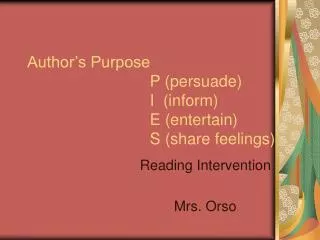
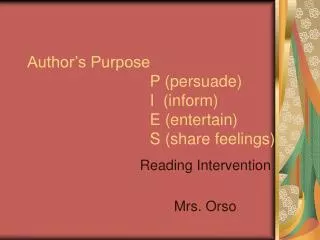
Author’s Purpose P (persuade) I (inform) E (entertain) S (share feelings) Reading Intervention Mrs. Orso
P (persuade) • Persuade means to try to get someone to think the same way you do • Examples Advertisements, newspaper editorials, posters
I (inform) • Inform means to give someone information about something • Examples news reports, research papers, encyclopedias, school news letters, instructions, maps, timelines, schedules, pamphlets from health clinics
E (entertain) • Entertain means to amuse someone • Examples fictional stories, comics, jokes, poems, riddles
S (share feelings) • Sharing feelings means to tell the reader what you are thinking • Examples journals, diaries, letters
What’s the Author’s Purpose? • A sales ad wanting you to purchase a motorcycle
What’s the Author’s Purpose? • The list of movies showing at the theater and time
What’s the Author’s Purpose? • The comic strips
What’s the Author’s Purpose? • A postcard from your friend in Hawaii
What’s the Author’s Purpose? • A letter to the editor explaining the need to recycle more
What’s the Author’s Purpose? • A fairy tale
Fact and Opinion • What’s the difference???
Fact • A fact is based in truth and can be proven (or disproved). • FACTS January always has 31 days. January in Australia is a summer month. The average temperature in Birmingham during the month of January is 41.5 F
Opinion • An opinion is based on personal feelings, beliefs or preferences. • Opinions January is a good month to stay inside. January is my favorite month. Jasmine would rather spend the month of January in Australia than in Birmingham.
Fact VS. Opinion • Fact and opinion are not the same as asking if something is true or false. • A statement presented as a fact may be proved (or disproved), and an opinion is often a true statement. • Look on page 71 and complete the PRACTICE.