Download
1 / 12
120 likes | 233 Vues
This document summarizes the latest combined results from the CDF and D0 Higgs sensitivity committees as of June 18, 2003. Incorporating improved data on lnbb and nnbb, this analysis enhances sensitivity through various methods such as NN enhancements, extended lepton and b-tagging capabilities, and improved mass resolution. The statistical analysis includes Bayesian and CLs methods, yielding consistent results with lower luminosity thresholds for the ZH channel. The findings indicate significant acceptance through the WH channel while minimizing overlaps with lnbb channels.

E N D
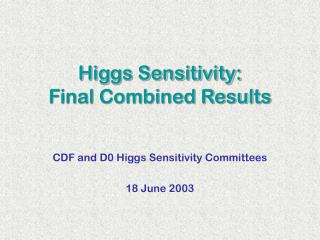
Higgs Sensitivity:Final Combined Results CDF and D0 Higgs Sensitivity Committees 18 June 2003
Recent Developments • have new numbers for both lnbb (from CDF) and nnbb (from D0) with bug fixes, etc. • incorporate NN enhancement to lnbb: multiply Sx0.90, Bx0.63 (C. Neu thesis) • incorporates extended lepton and b tagging into lnbb (with high eta roll-off; Winer, MMP) • use improved mass resolution for lnbb (Dorigo, Scodellaro) • incorporate llbb into ZH channel • combine all channels
WH channel • extended lepton/b tagging • 10% mass resolution • NN factor applied: • 1.6xS, 1.6xB
b tagging • include efficiency out to |h|=2, but must incorporate realistic “rolloff” • SHW assumed flat efficiency out to |h|=2 • assume no degradation due to multiple interactions
Statistical methods • Two approaches, both using mass spectrum: • Bayesian - integrate likelihood, taking into account systematics by integrating them out • CLs - used by LEP 2, takes into account systematics by maximizing likelihood at zero signal and SM cross section value; frequentist limit • CLs method agrees with Bayesian for 95% CL exclusion, but find ~10% lower luminosity thresholds for discovery
ZH channel from D0 • incorporate llbb by scaling signal and background by 1.33 • uses NN for selection • sensitivity better than SHW report • significant acceptance from WH channel! Need to ensure that there is no acceptance overlap withlnbbchannel
HSG vs SHW at 115 GeV mass window: 98-130 GeV
Higgs Sensitivity Versus Mass bands are ~30% wide to account for systematics and statistical method
HSG compared with SHW bands are ~30% wide to account for systematics and statistical method