Understanding Polar Molecules: Bonding and Electronegativity Explained
This lesson focuses on polar molecules, their structures, and the differences between polar and nonpolar covalent bonds as well as ionic bonds. Using creative representations, including penguins and polar bears, students will draw Lewis dot structures for hydrogen and chlorine, respectively. They will explore the concept of electronegativity and its effect on bonding. By the end of the session, students will be able to define polar molecules and explain the significance of intermolecular forces, while also completing a vocabulary chart for reinforcement.

Understanding Polar Molecules: Bonding and Electronegativity Explained
E N D
Presentation Transcript
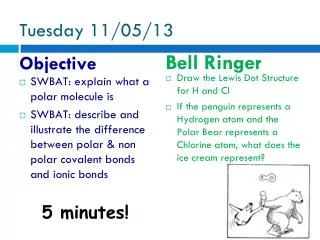
Tuesday 11/05/13 Objective Bell Ringer Draw the Lewis Dot Structure for H and Cl If the penguin represents a Hydrogen atom and the Polar Bear represents a Chlorine atom, what does the ice cream represent? • SWBAT: explain what a polar molecule is • SWBAT: describe and illustrate the difference between polar & non polar covalent bonds and ionic bonds 5 minutes!
Tuesday 11/05/13 Objective Bell Ringer Draw the Lewis Dot Structure for H and Cl If the penguin represents a Hydrogen atom and the Polar Bear represents a Chlorine atom, what does the ice cream represent? • SWBAT: explain what a polar molecule is • SWBAT: describe and illustrate the difference between polar & non polar covalent bonds and ionic bonds 4 minutes!
Tuesday 11/05/13 Objective Bell Ringer Draw the Lewis Dot Structure for H and Cl If the penguin represents a Hydrogen atom and the Polar Bear represents a Chlorine atom, what does the ice cream represent? • SWBAT: explain what a polar molecule is • SWBAT: describe and illustrate the difference between polar & non polar covalent bonds and ionic bonds 3 minutes!
Tuesday 11/05/13 Objective Bell Ringer Draw the Lewis Dot Structure for H and Cl If the penguin represents a Hydrogen atom and the Polar Bear represents a Chlorine atom, what does the ice cream represent? • SWBAT: Contrast physical and chemical properties and changes. • SWBAT: Calculate density of substances. 2 minutes!
Tuesday 11/05/13 Objective Bell Ringer Draw the Lewis Dot Structure for H and Cl If the penguin represents a Hydrogen atom and the Polar Bear represents a Chlorine atom, what does the ice cream represent? • SWBAT: explain what a polar molecule is • SWBAT: describe and illustrate the difference between polar & non polar covalent bonds and ionic bonds 1 minute!
Tuesday 11/05/13 Objective Bell Ringer Draw the Lewis Dot Structure for H and Cl If the penguin represents a Hydrogen atom and the Polar Bear represents a Chlorine atom, what does the ice cream represent? • SWBAT: explain what a polar molecule is • SWBAT: describe and illustrate the difference between polar & non polar covalent bonds and ionic bonds 30 seconds!
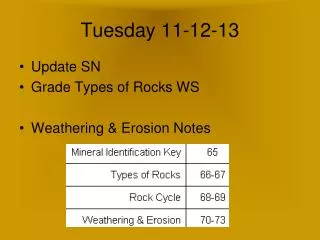
Tues. November 5, 2013 Announcements Please take out your notebooks! Write the homework in your assignment notebook… now! Objective • SWBAT: explain what a polar molecule is • SWBAT: describe and illustrate the difference between polar & non polar covalent bonds and ionic bonds Homework: Complete vocabulary chart & polarity questions
Tuesday 11/05/13 --Recap Objective Bell Ringer Draw the Lewis Dot Structure for H and Cl If the penguin represents a Hydrogen atom and the Polar Bear represents a Chlorine atom, what does the ice cream represent? • SWBAT: explain what a polar molecule is • SWBAT: describe and illustrate the difference between polar & non polar covalent bonds and ionic bonds
VOCABULARY TODAY! Draw this chart in your notebook, complete for HW
Cornell Notes: Please take out your notebook and properly set up your paper. Topic: Polar Molecules & Electronegativity Date: 11/05/2013 Essential Questions: Explain in your own words what a polar molecule is. How does electronegativity effect bonding?
Polar & Non Polar Molecules • POLAR MOLECULE: A molecule that has a negatively charged end and positively charged end • Nonpolar molecules: Molecules that are not attracted to a charge.
Polar Molecules • One end of a polar molecule has a partial negative charge, and the other end of the molecule has a partial positive charge.
The partial charges on polar molecules cause individual molecules to be attracted to each other.
Intermolecular Forces • Intermolecular forces: The forces of attraction that occur between molecules. All molecules interact with each other, but the attractions between polar molecules tend to be stronger than those between nonpolar molecules.
Check In: In your Cornell Notes answer the following questions • Explain in your own words what a polar molecule is • What are intermolecular attractions? 5 MINUTES
What Makes A Molecule Polar? • Polarity in a molecule is caused by unequal sharing of electrons between atoms. • Electronegativity is the tendency of an atom to attract shared electrons. • Anytime two atoms with different electronegativity values share electrons, there will be a partial negative charge on one atom and a partial positive charge on the other atom.
The Bare Essentials of POLARITY • As we read about Electronegativity, continue to take notes! • You will need these to answer your Exit Ticket Questions! • Your HW is to complete the vocabulary chart that you created at the beginning of class!!